
If you look at the first image in this article, you might recognize the artist’s very distinctive style even if you do not know his name and think, “Oh, right — that’s the guy who drew cats and then went mad!” You may even remember the familiar story that, as his illness progressed, he supposedly drew increasingly strange animals until they eventually dissolved into almost unimaginable forms. And someone might add: “The man was happily drawing cats, and then his evil sisters had him committed to an asylum.”
This blog post is also available in Russian.
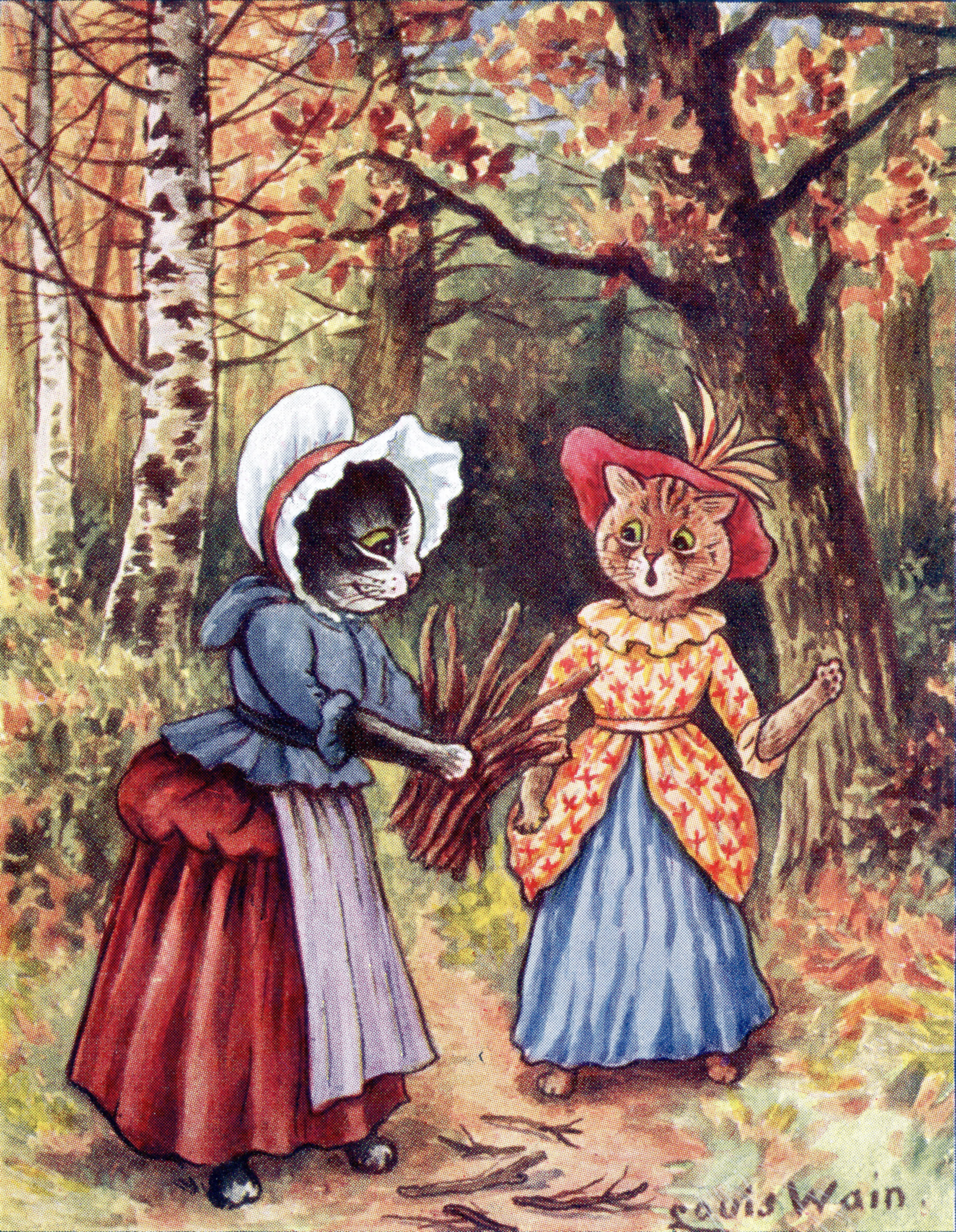
Whatever is the Matter, Priscilla, my Love?
Well, this really is “that guy” — the English artist Louis Wain, whose career stretched from the late nineteenth century into the 1930s. But his story is much more complicated than “his evil sisters drove him mad, and then he started drawing fractal cats.” He was an unusual man who had a difficult life, adored cats, and believed them to be far more intelligent than people generally assumed. More than that, he created an entire nation of cats. In Wain’s pictures, the animals behave just like humans: they do household chores, play tennis, go for walks, read books, and even attack the law-abiding “citizens” of this imaginary country.
In my humble opinion, Wain was ahead of his time. His work would fit perfectly into the internet culture of the 2010s and 2020s, with its memes, stickers, and endless cat merchandise. Cats were already common household animals in Victorian Britain, but it was during this period that their social status began to change rapidly. Alongside their traditional role as mousers, they were increasingly becoming full-fledged companions, while pedigree breeding, cat clubs, and cat shows began to emerge. The first major modern cat show in Britain, which we will return to later, was held in London in 1871.
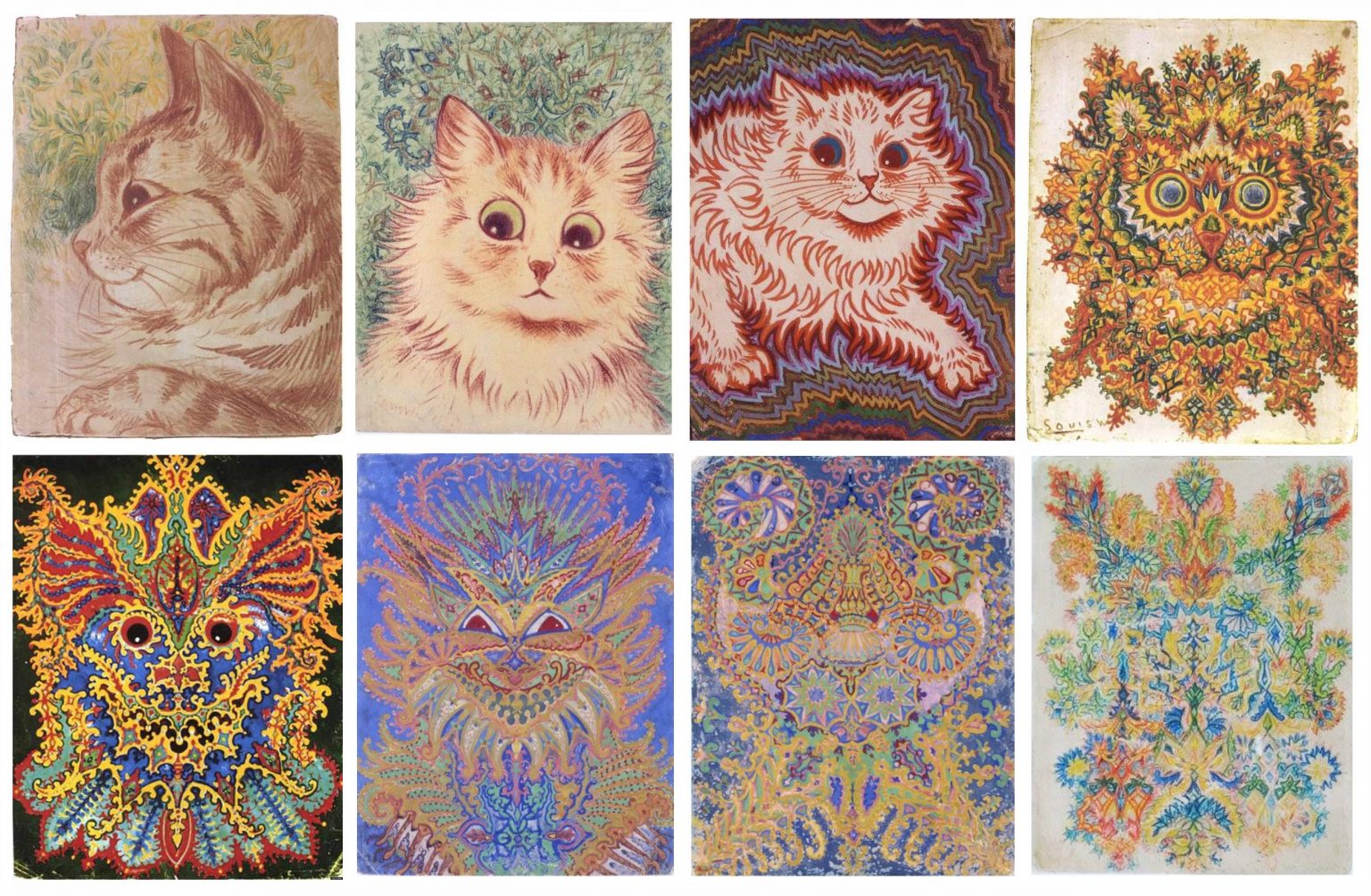
The famous "kaleidoscopic cats"
I started working on this article because I wanted to understand Wain’s life and ideas better, while also checking some of the myths surrounding him. Unfortunately, people are generally very good at believing all sorts of legends, whether beautiful or horrifying — something I have already seen while working on several true crime stories.
I am neither an artist nor a historian, but perhaps in some ways that is for the best. This is not going to be a “smart” article written for specialists. Rather, it is an attempt to bring together what can actually be established from the surviving sources: books, newspapers, contemporary recollections, and even Wain’s medical records, some of which rarely appear in popular accounts of his life.
So, let us begin.
Sources
Before going any further, it is worth briefly listing the main sources I will be referring to throughout this article.
First, there is Rodney Dale, Louis Wain: The Man Who Drew Cats, revised edition, 1991 — probably the single most important biographical source, directly or indirectly relied upon by most authors writing about Wain. Dale was his first full-scale biographer: the original edition of the book appeared back in 1968. Interestingly, the section dealing with Wain’s illness was originally written by psychiatrist David L. Davies. For the revised 1991 edition, however, those chapters were substantially reworked, and Dale took responsibility for the final text himself.
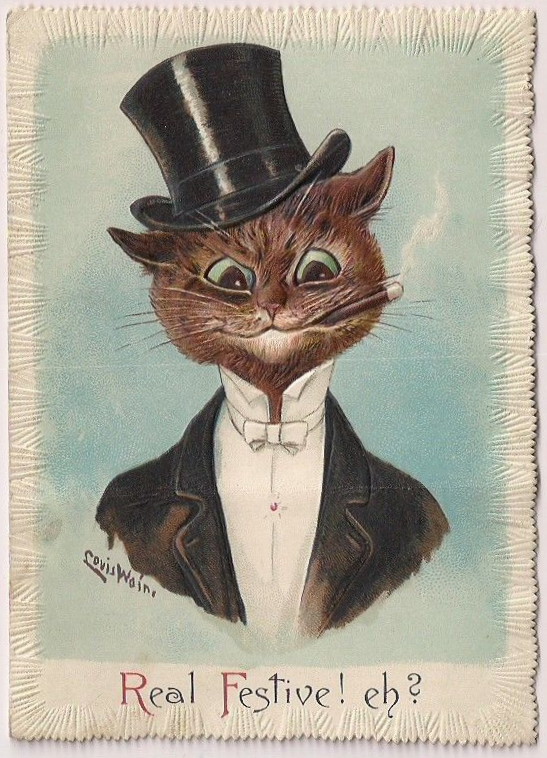
Real Festive! Eh?
The difficulty is that in several important parts of the book — particularly those dealing with Wain’s illness — Dale does not cite specific documents and instead refers only to conversations with people who knew the story well. I wanted to understand where exactly this information came from and how accurately he had reproduced it. At first, I hoped to send a few questions to Rodney Dale himself, but sadly, he died in 2020. That left only one option: contacting British archives and looking for the documents myself.
As the saying goes, manuscripts do not burn, and I suspected that records from the hospitals where Wain had been treated must have survived in some form. Before long, I got lucky: the Museum of the Mind at Bethlem Royal Hospital still holds Louis Wain’s medical record from 1925–1930 (CB-216). Bethlem is one of the oldest psychiatric institutions in England, and the museum archive preserves records dating back as far as the sixteenth century. Better still, archivist David Luck was kind enough to provide me with copies of every page in Wain’s record. It contains information about his condition on admission, family history, diagnosis and behaviour, as well as regular medical notes covering the years he spent at Bethlem.
There is, however, one problem: the document is around a century old, several doctors had handwriting that qualifies as a form of punishment in its own right, and some words are almost impossible to decipher. Even so, I think I managed to make out at least 80% of the text. One important note from the outset: I am not permitted to publish photographs of the medical record itself on the blog, so the article will contain only transcriptions of selected passages.
I also managed to find documents covering the earlier period of Wain’s hospitalization. The London Archives holds the records of Springfield Hospital (H46/SP), where Wain was admitted in 1924. His individual case file does not appear to have survived, but archive staff found entries relating to him in several different registers. I obtained copies of the admission register, the civil register, and the register of patient transfers. Together, they confirm Wain’s admission date, his hospital registration number, the recorded duration of his current attack, several administrative details, and finally his transfer to Bethlem on 24 August 1925 with the notation not improved. We will examine these documents in detail later.
Another important source is Patricia Allderidge, who began working at Bethlem in 1967 and spent more than three decades there as an archivist and curator. According to the museum’s current archivist, Allderidge had an exceptional knowledge of Wain’s life and work and was regarded in her time as one of the leading experts on him.
Dale explicitly states that while preparing the revised edition of his book, he discussed Wain with Allderidge on numerous occasions. In 1997, she also published a short monograph, Louis Wain and the Myth of the Disintegrating Cat, which I have used in preparing this article. It is particularly valuable because Allderidge examines the famous series of “disintegrating” cats in detail and shows just how shaky the attempt was to present those images as a sequential record of Wain’s mental deterioration.
There is still a gap when it comes to the final period of Wain’s life. In 1930, he was transferred from Bethlem to Napsbury Hospital, where he remained until his death in 1939. The hospital archive survives only in part and is now divided between several repositories. I have already contacted the Wellcome Collection, which holds a small collection of Napsbury records from 1927–1956 (GC/135), but staff confirmed that it contains no individual patient case files. The main Napsbury collection (H50) is held by The London Archives; some registration records relating to Wain survive there, but so far I have been unable to locate his medical record from this period.
Most of the artwork reproduced in this article comes from Catland, whose creators deserve a separate thank-you.
With all the necessary preliminaries out of the way, let us move on to the main part of the article.
Childhood and youth

Billiards
Louis’s father, William Wain, came from the family of a Staffordshire silk manufacturer, while William himself worked as a commercial traveller for a drapery firm. After moving to London, he met Julie Boiteux at a local church. She was the daughter of the French painter Louis Antoine Marie Boiteux, who had settled in England. William and Julie married in October 1859, and in August of the following year their first child was born — a boy named Louis after his grandfather. Five daughters followed: Caroline, Josephine, Claire, Felicie, and Marie.
Louis appears to have been a rather sickly child. He was also born with a cleft lip, which may be one reason he later almost always wore a moustache. According to his own recollections, doctors would not allow him to attend school until the age of ten, and as a young child he suffered from recurring nightmares. His relationships with other pupils were not particularly easy either, and Wain later recalled getting into repeated fights with boys who bullied him.
As he grew older, he became interested in politics, music, art, chemistry, and all sorts of scientific questions, and by his own account he spent a long time unable to decide which attracted him most. For a while, Wain seriously considered a musical career, learned to play the violin, and even wrote an opera that has not survived. Dale remarks that its quality is difficult to judge, since nobody ever agreed to stage it.
In the end, Wain chose drawing. He studied at the West London School of Art and later taught there for a time. By then his father had died, leaving Louis responsible for supporting his mother and five unmarried sisters. Teaching did not suit him particularly well: Wain was shy and rather eccentric, while he felt increasingly drawn toward working as an artist. In the summer of 1881, he even briefly left home, determined to make his own way in the world. Wain later described the moment in rather grand terms, claiming that some kind of “other, phantom being” appeared to him, showed him the path ahead, and told him to fight for his goal.
Wain’s autobiographical stories should, however, be treated with some caution. He claimed that as a young man he lived a luxurious social life in Mayfair, mixed with influential people, and could count on their patronage, even though he remained heavily dependent on his mother’s money. Dale doubts that this account should be taken too literally: the “powerful and intellectual friends” Wain later remembered remain entirely unidentified.
In any case, money was always short. After leaving home, Wain rented a furnished room, where he collected books and worked on his drawings; after his first professional successes, he returned to the family home. He later claimed that from around the age of twenty he had been taking commissions from small publications and producing work for colour printing, sometimes under different names.
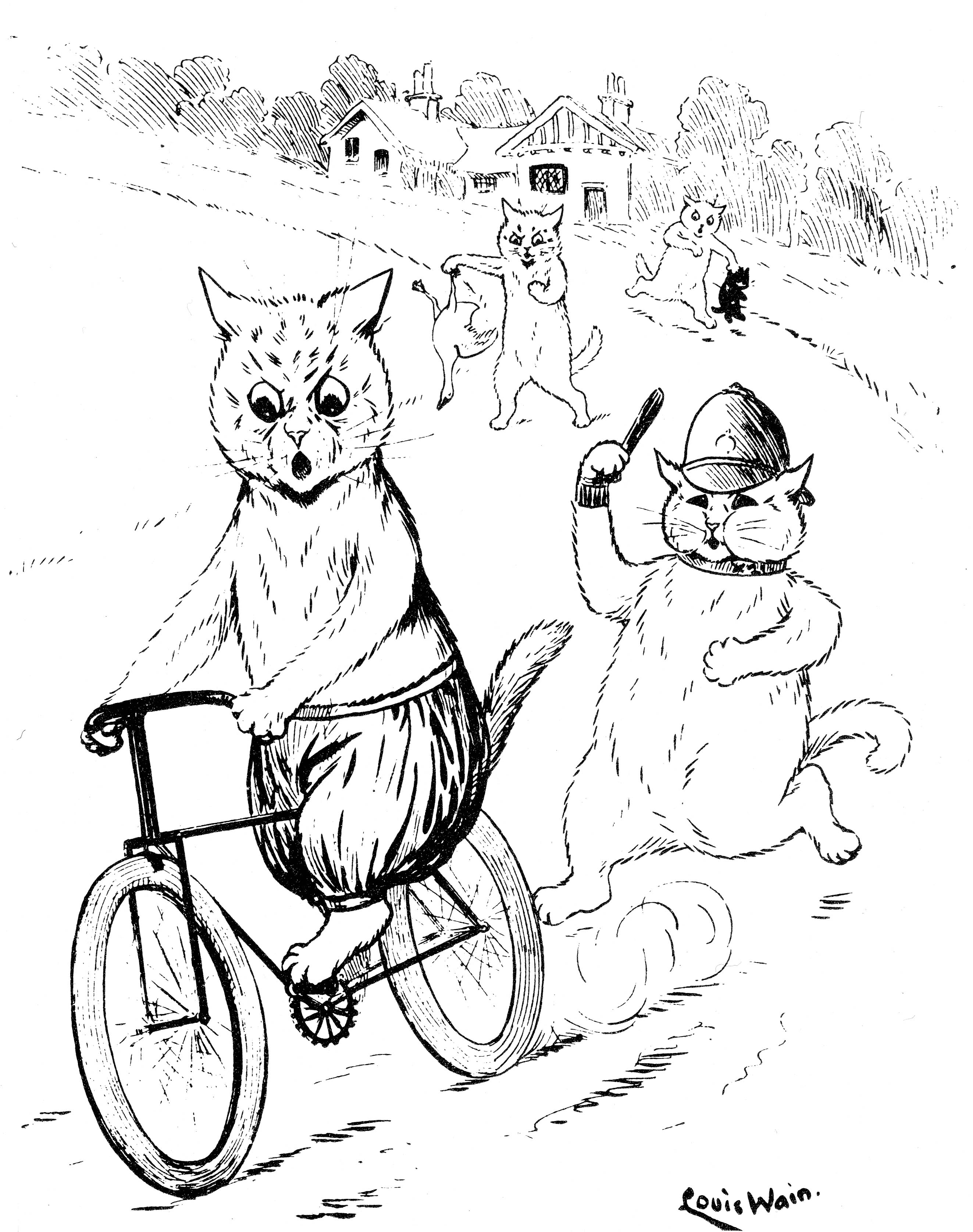
Title unknown
Dale also came across a children’s book, The Children’s Tableaux, published by Ernest Nister in 1895, containing several unsigned cat illustrations that struck him as similar to Wain’s early work. He was later contacted by a woman whose older sisters had worked for Nister back in the 1880s. According to her, they used to bring home printed sheets of Louis Wain’s drawings, which the children cut out and played with. On this basis, Dale suggested that some of the illustrations in The Children’s Tableaux may have originated in earlier anonymous work by Wain.
Around the same time, a governess named Emily Richardson came to work in the Wain household. Louis fell in love with her, and the two soon moved together to Hampstead, although the family apparently disapproved of the relationship. The issue was not merely Emily’s occupation, but also the fact that she was considerably older than Louis — something we will look at in the next section.
In any case, the couple married on 30 January 1884 at St Mary’s Chapel in Hampstead. None of their relatives attended the ceremony; according to Dale, the only witnesses were a woman and the artist Herbert Railton, a close friend of Wain.
How old was Emily Richardson?
Emily’s age, however, turned out to be a much more interesting and complicated question. Two different versions appear in biographies of Wain: Rodney Dale writes that she was about ten years older than Louis, while some modern sources put the difference at seventeen years. Trying to verify this detail against primary records unexpectedly turned into a small genealogical investigation.
The first lead came from the marriage index of the General Register Office (GRO) for England and Wales. Emily Marie Richardson and Louis Wain do indeed appear there in the first quarter of 1884: both entries refer to Hampstead, volume 1a, page 968. Curiously, the groom’s name is printed in the original index as Louis Marie Wain rather than Louis William Wain; FreeBMD later added a note clarifying that the entry refers to the artist Louis Wain and his marriage to Emily Marie Richardson.
The index itself does not give the ages of the bride and groom, so the next document to examine was Emily’s death record. The official GRO index contains the following entry:
Emily Marie Wain — 36 years — Hampstead — March quarter 1887 — vol. 1A, p. 477.
At first glance, this seemed to confirm Dale’s version perfectly: if Emily died in early 1887 at the age of 36, she must have been born around 1850 and would indeed have been roughly ten years older than her husband.
To check this, we ordered a digital image of the actual registration entry from the GRO. It confirmed both the identity of the deceased and the recorded age. Emily died on 2 January 1887; the document identifies her as the wife of Louis Wain, artist, and the informant was Louis himself — now a widower, who had been present at her death. Her age is indeed recorded as 36. There can therefore be no real doubt that this was Louis Wain’s wife rather than some unrelated woman with the same surname.
Then, however, another official record turned up. The GRO birth index contains an Emily Richardson registered in the second quarter of 1843 in the St George Hanover Square district; her mother’s maiden name is given as Andrews.

All At Sea
We ordered a digital image of this registration entry as well. It states that Emily Richardson was born on 6 June 1843. Her father was Thomas Richardson, a greengrocer, and her mother was Elizabeth Richardson, formerly Andrews. On its own, this still proved nothing: there could easily have been another Emily Richardson living in London. What made the record suspiciously relevant, however, was that no suitable Emily Richardson appeared in the birth index for 1849–1851. So the next step was to trace this particular family forward.
In the 1851 census, a seven-year-old Emily Richardson born in London does indeed appear in St Pancras. She is living with her mother, Elizabeth Richardson, who was born in Suffolk, and three siblings: Elizabeth, Henry, and Catherine. The age fits the birth date of 6 June 1843 perfectly: Emily had not yet turned eight when the census was taken.
The connection between this family and the surname Andrews can be checked independently. Emily’s brother, Henry Richardson, aged eight in the 1851 census, appears in the GRO index among births registered in Marylebone in the second quarter of 1842; his mother’s maiden name is given as Andrews. Her older sister, Elizabeth Richardson, who was born in Yorkshire, also appears in the GRO: her birth was registered in the Malton district in 1838, and once again the mother’s maiden name is Andrews. The family in the 1851 census is therefore almost certainly the same family of Thomas Richardson and Elizabeth Andrews named in Emily’s birth record.
The 1861 census provides even stronger evidence. Living in St Pancras, on Little Edward Street, are:
Elizabeth Richardson, aged 53, a widow born in Cookley, Suffolk;
her daughter Emily Richardson, aged 17, born in Pimlico;
her son Henry Richardson, aged 18, born in Marylebone.
If Emily was born on 6 June 1843, she would indeed have been exactly seventeen at the time of the 1861 census — once again, the age matches the birth record perfectly.
Finally, there is also a parish record. The FamilySearch collection England, Middlesex, Parish Registers, 1539–1988 contains a baptism entry for the same Emily. She was baptised in Marylebone on 17 August 1851; her parents are named as Thomas and Elizabeth Richardson, and her exact date of birth is given as 6 June 1843. In other words, the same date appears not only in the civil birth registration but also in a separate parish record created at the time of her baptism.
We can then move on to the 1881 census. Once again, an Emily Richardson appears in St Pancras — an unmarried governess living with her mother, Elizabeth. Emily’s birthplace is given as the London parish of St George, while Elizabeth’s is Cookley, Suffolk: the same key details seen in the earlier censuses. But Emily’s age is now suddenly recorded as 31, implying a birth year around 1850.
Records like this are probably the source of the version in which Emily was born around 1850.
The resulting chain of evidence looks like this:
1843: civil registration — Emily was born on 6 June; her parents were Thomas Richardson and Elizabeth Andrews;
1851: census — Emily is 7 years old;
1851: baptism — her date of birth is again given as 6 June 1843;
1861: census — Emily is 17, was born in Pimlico, and is living with the same Elizabeth Richardson;
1871: so far, I have been unable to identify Emily reliably in the census, despite specifically searching by name, age, birthplace, and various surname variants. This does not necessarily mean that no record ever existed: Emily may have been away from her usual residence on census night, she may have been omitted from the enumeration, or the relevant record may have been lost, damaged, or incorrectly transcribed during modern indexing. None of the candidates I found matched the known information closely enough, so I have not assigned any of them to Emily;
1881: census — the same family and the same Emily, now working as a governess, but her age is given as 31 when she should have been 37;
1887: death registration — Emily is described as the 36-year-old wife of the artist Louis Wain; Louis himself supplied the information.
The early records therefore consistently point to 1843, with two separate records giving the exact same date: 6 June 1843. The later documents, by contrast, reduce Emily’s age by six or seven years.
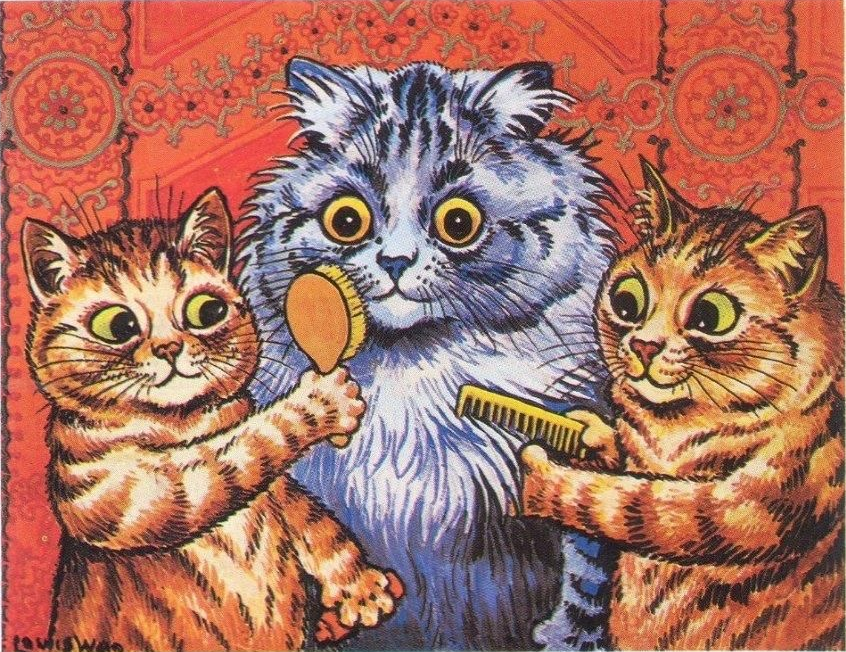
A Shadow Draped for Worldly Life - Sprucing Up
Why this happened is probably impossible to establish now. We do not even know who supplied Emily’s age for the 1881 census: Emily herself, her mother as head of the household, or someone else. In the 1887 death registration, the age was supplied by Louis Wain, who described his wife as 36. Of course, either a census enumerator or an informant could simply have made a mistake. What is striking, however, is the nature of the discrepancy: in two records created six years apart and under different circumstances, Emily’s age is understated by roughly the same amount, placing her birth at around 1850 in both cases. This raises the possibility that at some point Emily herself had begun giving a younger age, and that Louis later simply remembered that version of her biography. There is, of course, no way to prove this.
On the surviving documentary evidence, however, 6 June 1843 is by far the most convincing date. If correct, Emily was about seventeen years older than Louis Wain, who was born on 5 August 1860. At the time of their wedding, Louis was 23 and Emily was 40. Interestingly, we will later find some indirect support for such a substantial age difference in Wain’s medical records.
And Then Came the First Cat
Soon after the marriage, there was a new addition to the Wain household: a certain Peter, whom the artist would later call his household god. As you may have guessed, Peter was a cat — one who would remain Wain’s companion for fifteen years. Wain wrote about him with great affection and even claimed that “it is to him that the credit rightly belongs for laying the foundation of my career, developing my early efforts, and finally shaping my work.”
This meeting really did prove fateful, although it is still not entirely clear where exactly Peter — a black-and-white cat — had “come from.” Wain’s sisters later claimed that the animal had been something like a wedding gift, though Dale doubts that version — enough to recall that none of the newlyweds’ relatives attended the wedding at all. There is also a version according to which the artist received the cat as a gift for his twentieth birthday, but that clearly does not fit the chronology: Wain had turned twenty back in 1880. Finally, according to yet another story, Louis and Emily picked up a stray kitten mewing in the rain. In any case, Dale dates Peter’s birth to around 1883.
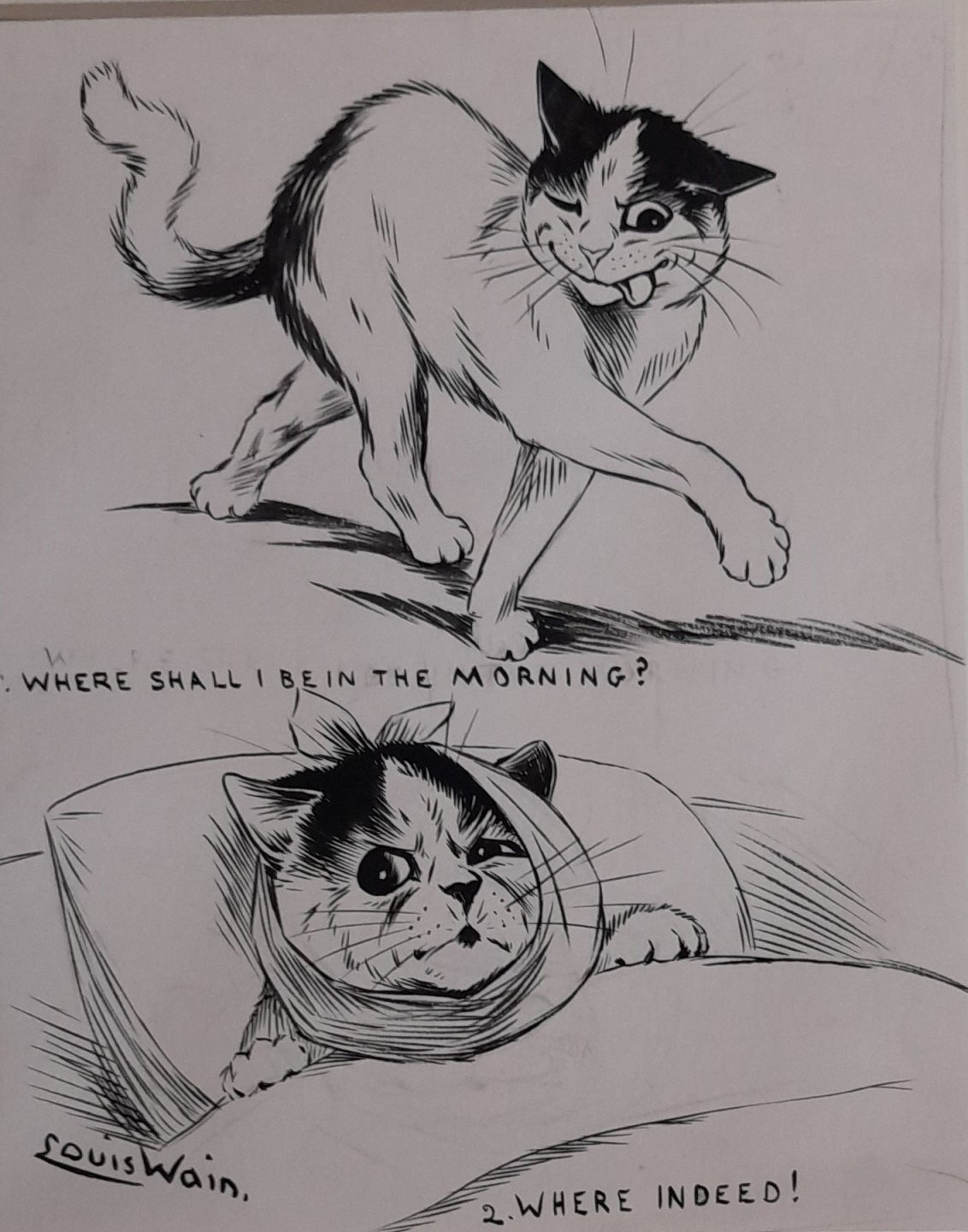
Sketches of Peter the cat
Things at home, however, were far from happy: because of progressing cancer, Emily spent more and more time in bed. Peter was constantly by her side, and Louis later recalled that the presence of the warm, furry companion eased her pain and helped her fall asleep. Dale remarks, however, that “it is curious that he [Louis] seems to show almost no emotion over his wife’s suffering: the important figure for him is Peter.”
Personally, I find that claim rather debatable, although it is true that Wain builds his account of his wife’s difficult fate around Peter. To amuse Emily, Wain began teaching the cat tricks and drawing him in all sorts of situations. Louis often worked while sitting beside his sick wife’s bed, and the cat proved to be an excellent “model.” Emily advised her husband to show these sketches to publishers, but he believed no one would be interested.
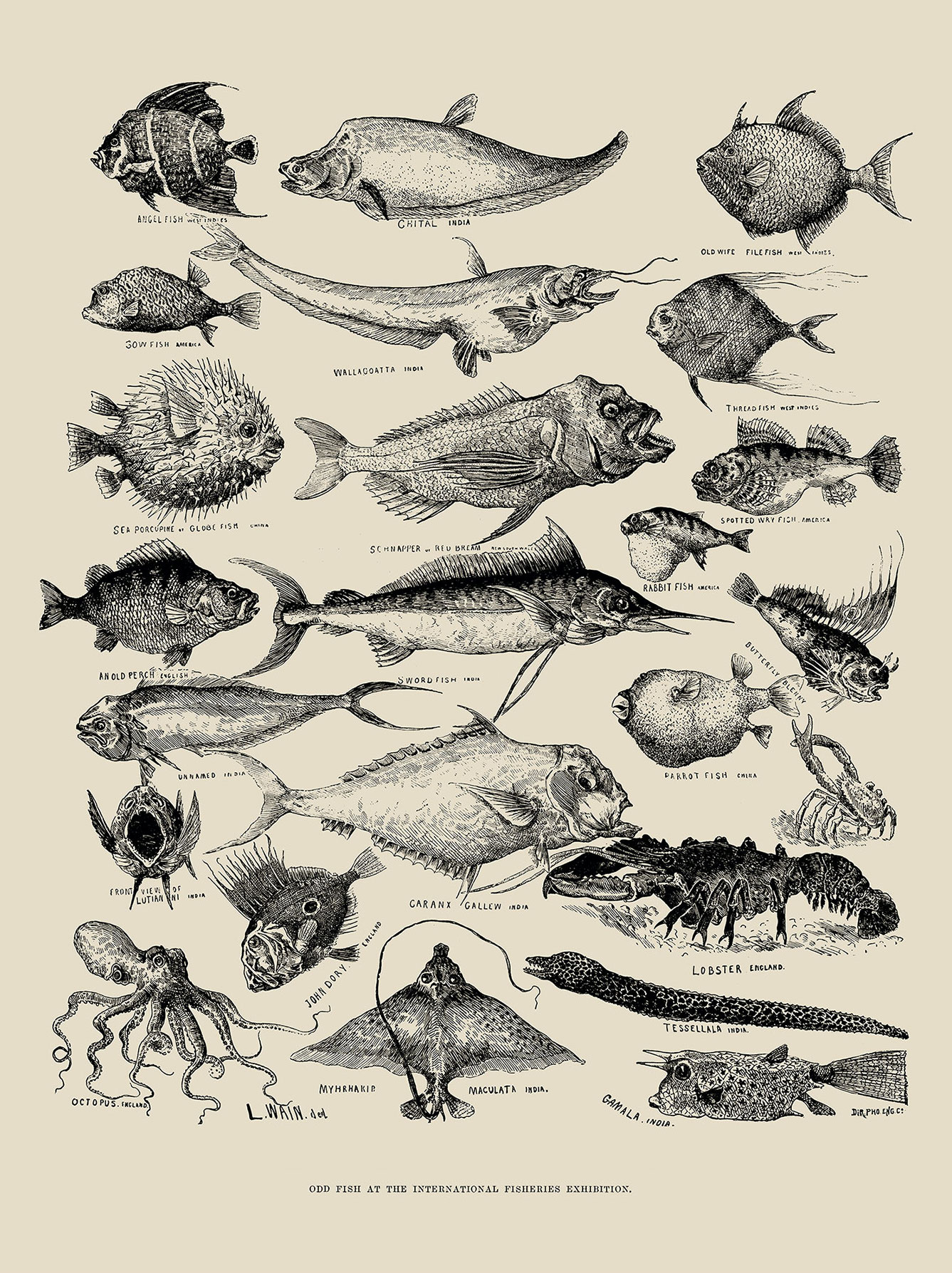
Odd Fish at the International Fisheries Exhibition
The first drawing Wain published under his own name in Illustrated London News appeared in 1883 and was titled Odd Fish at the International Fisheries Exhibition. The very next year, the magazine printed A New Dog-Fancy: The Basset Hounds, in which three cats appear among the dogs — two of them drawn from Peter. It is quite interesting that at this stage Louis drew many dogs and other animals: cats had not yet become his signature subject. And their place in the Victorian home was somewhat different from what it is today: cats were already kept as pets and shown at exhibitions, but their status was still far less firmly established than that of dogs.
In 1884, Wain published Our Cats: A Domestic History — one of his early narrative series featuring Peter in the leading role. In the story, the cat is neglected because his owners have gone to the seaside, and as a result he falls out of condition and can no longer perform well at the cat show in Crystal Palace. So even before the famous anthropomorphic scenes, Wain was already turning cats into the heroes of little comic stories.
It very much seems that the black-and-white cat really did change the direction of Wain’s career. Later on, our hero recalled that “good old Peter” was extraordinarily intelligent: he obeyed commands, could sit with spectacles on his nose, hold postcards in his paws, and wait by the door for his master’s return. More generally, Louis believed that the intelligence of cats was greatly underestimated. As an example, he told an amusing story. At night, mysterious noises could be heard in the house, and guests sometimes took them for the footsteps of a ghost. The culprit turned out to be Peter: he would lift the edge of the doormat and let it drop again, repeating this at regular intervals until someone opened the door for him.
It should be said that other cats later appeared in Wain’s household as well. According to one eyewitness, acquaintances brought Louis abandoned kittens, and before long there were so many furry residents in the house that some of them had to move out into the yard. Despite this, Peter always remained a kind of patriarch — or “proto-cat,” as the artist called him.

The New Dog Fancy - Bassett Hounds
Still, we know the names of some of the artist’s other favourites as well: Leo, a long-haired tabby; Minna, a small cat of a French breed; and Bigit (an incorrect version of the name, “Brigit,” can be found online). The last of these was a magnificent Siamese cat, and Louis — clearly exaggerating — claimed that he was so enormous that the neighbours took him for a wild predator escaped from the zoo.
The road to fame
Emily died in 1887, and Louis moved with Peter into the home of an old acquaintance, Mrs Hayes, where he appears to have rented rooms.
Around the same time, Wain gradually began moving in the circles of London artists and journalists. In 1925, Alfred Praga recalled frequently meeting Louis at the studio of the well-known artist Phil May. Wain also attended Praga’s musical evenings, where he improvised at the piano and surprised those present with unusual harmonies. His love of music had clearly never disappeared: Praga also remembered Wain talking about several operas he had written and still hoped one day to see performed on stage.
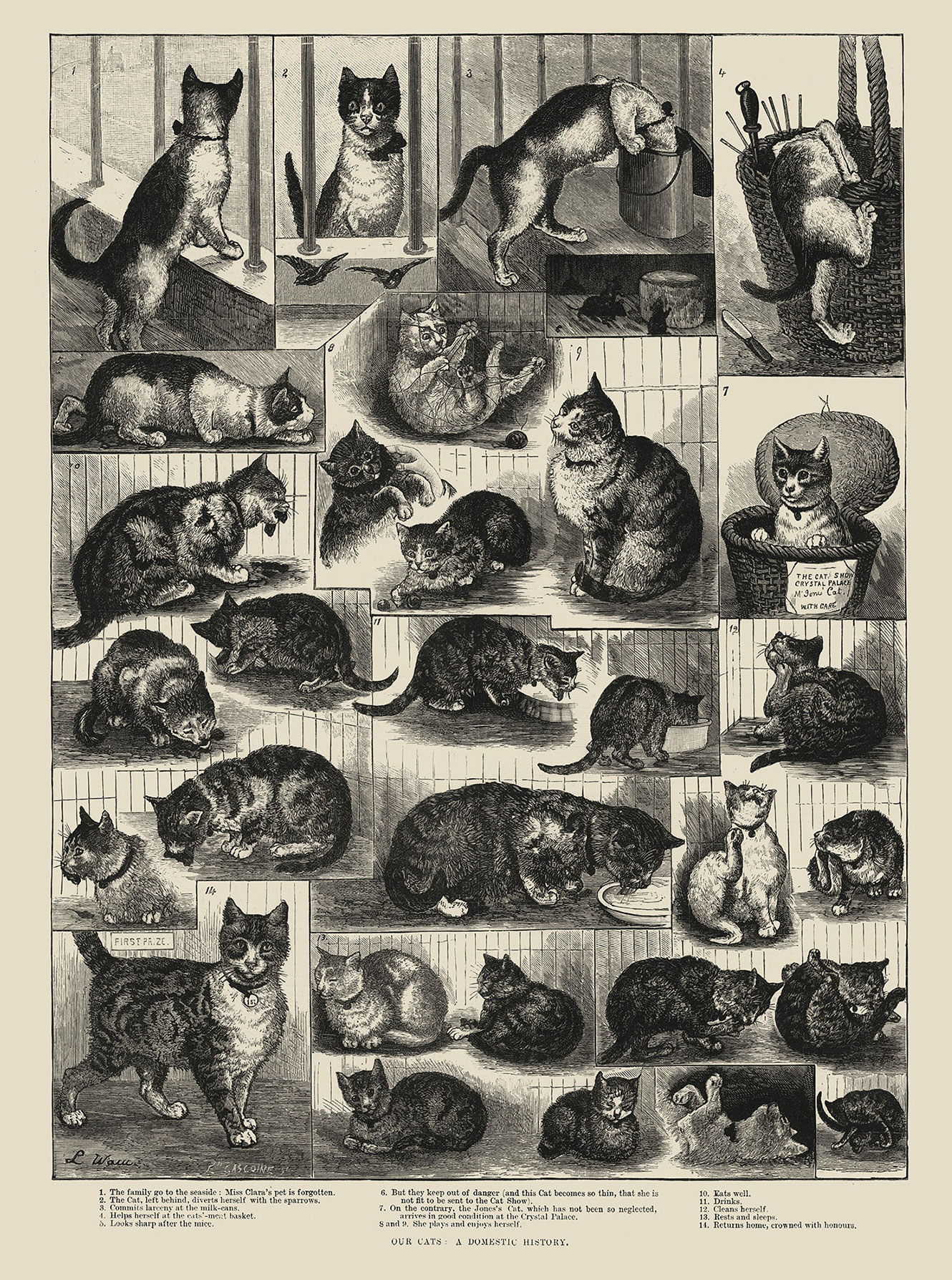
Our Cats, a Domestic History
According to Praga, however, Wain’s favourite subjects of conversation were not cats at all, but various mystical and “psychic” phenomena. That interest in mysticism was hardly unusual for the period in itself. Arthur Conan Doyle, for example, was already taking a serious interest in paranormal research in the 1890s and joined the Society for Psychical Research in 1893. In any case, it is striking that a man already inseparably associated with cats in the public imagination apparently spoke very little about them in ordinary conversation.
By around 1890, the unmistakable “Wain cat” we recognize today had begun to take shape. The animals were becoming less like ordinary cats and more like human beings in feline form. Wain himself gave a rather interesting explanation of his method. At times he would take a sketchbook to a restaurant or some other crowded place, observe the people around him, and draw their poses and facial expressions while immediately imagining them as cats. According to Wain, he considered sketches of this kind his best humorous work. Dale likewise places the birth of the recognizable “Louis Wain cat” at around 1890.
That same year, Wain was elected president of the National Cat Club, succeeding Harrison Weir, one of the founders of Britain’s pedigree cat movement. It is interesting that Wain’s rapid rise in popularity coincided with a period in which cats themselves were becoming increasingly fashionable as household pets. Of course, it would be far too simple to attribute that change to Wain alone: attitudes toward cats had already begun to shift before his rise to fame and were part of a much broader social trend.
“Cat science”

Title unknown
By this point, Wain had acquired a reputation as a genuine expert on cats and, according to later recollections, even planned to write a substantial book covering almost every aspect of the subject. As already mentioned, Louis was convinced that cats were far more intelligent than people generally assumed and that they could be trained very successfully — humans simply lacked the patience required to bring out their abilities. Wain claimed that he raised his own animals entirely through kindness and believed that even the wildest cats could gradually be taught not to fight or steal.
I should note that I am personally inclined to agree with him on this point. We managed to teach our British cat at least six or seven different commands, and she clearly understood what she was and was not allowed to do. Whether that knowledge actually prevented her from getting up to mischief was another matter entirely.
Some of Wain’s advice still sounds perfectly reasonable today. He was strongly opposed to physical punishment: in his view, a cat should never be hit, since a stern voice was usually enough to make it understand that its owner was displeased. Modern specialists, of course, tend to go further and recommend relying on positive reinforcement rather than punishment at all. Wain also advised giving the animal its own place to sleep, keeping fresh grass available for it, and using orange peel if a cat needed to be discouraged from going somewhere. There is some sense in that last suggestion as well: many cats dislike the smell of citrus, although it would probably be unwise to treat this as a universal rule.

Title unknown
Alongside these perfectly sensible recommendations, however, there are some far more exotic ones — such as keeping a small bag of sulphur in the cat’s basket, presumably to repel fleas and other parasites. The further Wain tried to explain the cat scientifically, the stranger his theories became. He believed that contact with cats worked almost like medicine: people who regularly held them, he claimed, did not suffer from nervous disorders, hysteria, or even rheumatism. Wain himself recalled that after long periods of mental work he would relax by talking to Peter or letting cats sit on his shoulders. Dale, with a fair amount of dry irony — whether justified or not is for the reader to decide — remarks that the claim that all cat lovers enjoy excellent temperaments and freedom from nervous problems sounds somewhat curious coming from Wain.
Louis’s views on the transformation of the cat from a useful mouser into a genuine household companion are particularly interesting. He believed that men had historically regarded cats mainly as a convenient means of controlling rodents, while women deserved most of the credit for raising their status in the home. Their patience and care, he argued, had “saved the cat from savagery” and ultimately secured it a permanent place in human households. Wain may have been drawing here, at least in part, on the traditional idea of the woman as the keeper of the home.
At times, Wain’s “cat science” took some rather strange forms. He speculated about the inheritance of temperament and coat colour, believed the feline brain to be especially vulnerable to powerful impressions, and claimed that a sudden change of surroundings could cause such severe stress that a cat might stop eating and even die. There is indeed a grain of truth in this: severe stress can cause cats to lose their appetite, and prolonged fasting can be dangerous for them. But Wain would then drift back into much shakier physiology, claiming that an intense fright could literally “paralyse its brain.”
Still, Dale notes that Wain’s popularisation of cats probably did the animals far more good than harm.
Moving away and reconciling with his family
Around 1894, Wain reconciled with his family, after which Louis, his mother, and his sisters moved to Westgate-on-Sea, a seaside town in Kent. During this period, the artist devoted a great deal of time to sport, including boxing and fencing. These seem to have been some of the happiest and most peaceful years of his life. In an 1895 interview quoted by Dale, Wain says that he works twelve or even fourteen hours a day, and not only on pictures: he is writing a humorous story, studying chemistry, and developing inventions that he hopes to patent.
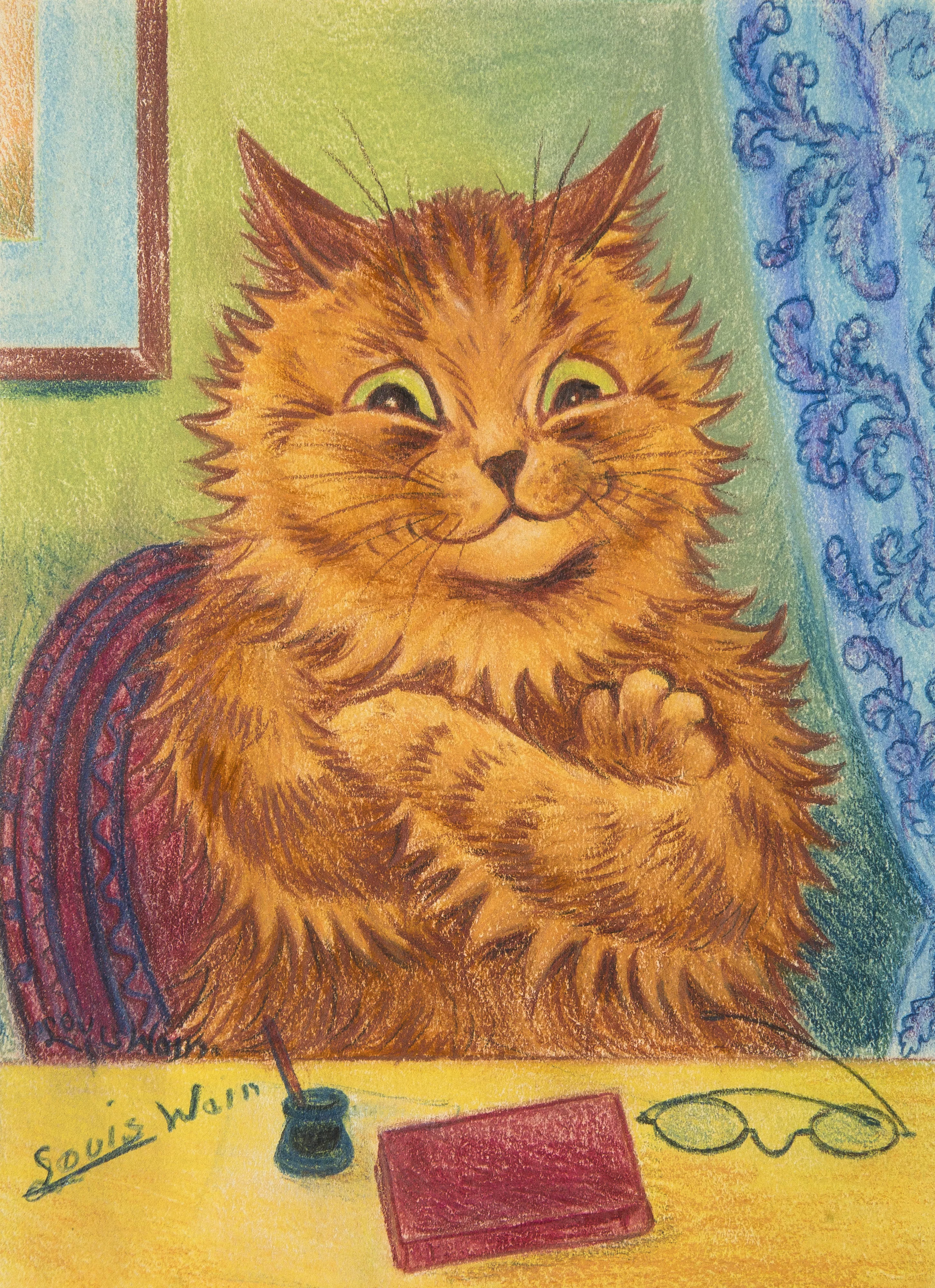
Scholar At Work
As you have probably gathered by now, Wain’s scientific ideas were, to put it mildly, rather unconventional. For example, he tried to explain Peter’s calming effect on the sick Emily through electricity — a subject that, in those days, seemed to fascinate almost everyone. In Wain’s view, the cat was a small “electric battery,” his wife a larger one, and the transfer of some kind of electrical fluid from one body to the other supposedly produced that pleasant warmth. Wain even tried to determine the nature of this electricity and work out the role of positive and negative charges, although the exact course of his reasoning has not survived.
The journalist Stanhope Sprigg wrote about these ideas in an article from the late 1890s. Wain seriously argued that cats possessed a kind of magnetic property: at one point, he became convinced that they preferred to move northward and even aligned their bodies with the points of the compass. He connected this with the “electrical force” of their fur and imagined the cat as a kind of miniature lightning conductor whose orientation depended on the animal’s positive or negative “temperament.” According to Wain, these ideas were inspired in part by observations of London cats, which supposedly preferred to travel along walls running in particular directions.
And that was not the end of Wain’s “cat electricity.” He rejected the folk belief that a cat washing itself could be used to predict the weather, but replaced it with an explanation no less exotic: while grooming, the animal supposedly “completed an electrical circuit,” thereby producing heat and creating a pleasant sensation in its fur. Dale remarks with some bewilderment that it is difficult to believe Wain meant all of this seriously, but the artist’s surviving statements suggest that he probably did.
At the same time, Wain clearly kept an eye on the “real” science of his day. According to Dale, in one interview from the late 1890s the artist claimed that he read publications of the Royal Society and was particularly interested in toxicology. His fascination with electricity also grew out of fertile ground: this was the age of the highly publicised experiments of Hertz, Tesla, and other researchers working with electricity and electromagnetic waves. The only problem was that Wain tended to move rather quickly from genuine scientific discoveries to theories of his own.
Research and patents
At some point, Wain’s imagination moved far beyond feline physiology. He speculated about the existence of some kind of “principle of life” that could be preserved in a dormant state, transmitted electrically through space, and used to seed Mars or other planets with life. Once placed in a new environment, a tiny cell might awaken and develop in an entirely different way — for example, growing into an enormous creature under unfamiliar conditions.
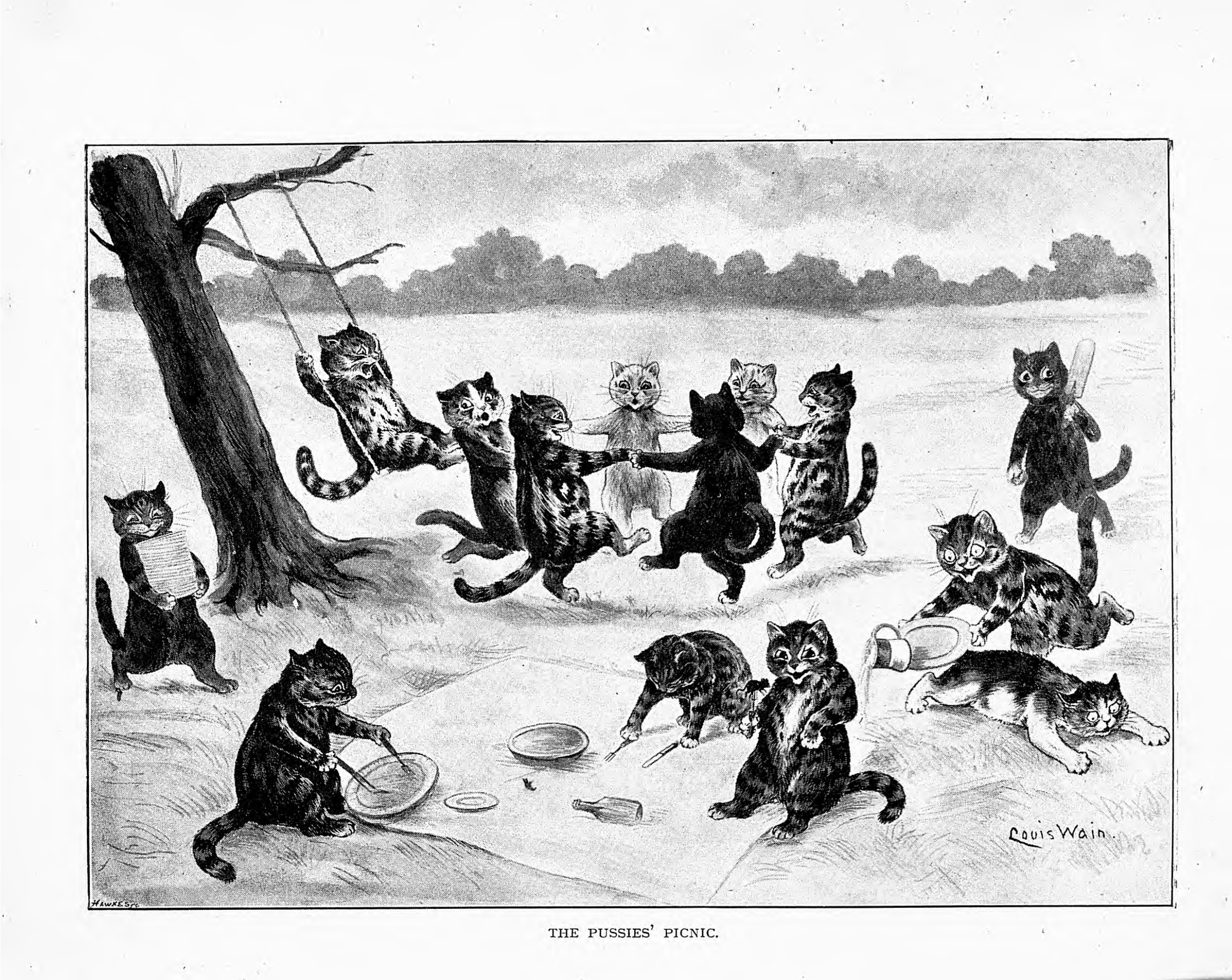
The Pussies' Picnic
Wain suggested that human speech could somehow be literally recorded inside such cells, almost like sound on a phonograph record, and then sent to other planets. There, they were supposed to come to life and pass the encoded language on to unknown intelligent beings — perhaps even beings of a spiritual nature.
Today, of course, all of this sounds thoroughly fantastical. But for our purposes, something else is more important: ideas like these were already being recorded in the 1890s, several decades before Wain was hospitalized. Later, electricity, “ether,” unusual physical influences, and ideas involving poisoning would reappear in his medical records. The last theme is especially interesting: Wain’s interest in chemistry and toxicology was not in itself unusual, but in the psychiatric records his talk of poisoning would take on a very different character.
His ideas did not remain purely theoretical. From time to time, Wain genuinely tried to invent things. Dale found three patent applications under his name in The Illustrated Official Journal (Patents) — for something called the Steady Cycle in 1894, a “new attachment for bicycles” in 1895, and a rangefinder in 1915. All three applications were later abandoned, and Dale was unable to find further details about the inventions themselves. The biographer is rather sceptical about Wain’s engineering abilities and suspects that he was more likely to file applications in bursts of enthusiasm than to develop devices with serious plans for production.
Letters and recollections
Wain was also quite fond of writing to newspapers, especially when he believed he had identified some kind of social problem. One of the most curious examples appeared in the Morning Post on 15 October 1902 under the rather ominous title The Doomed Empire. His argument begins with free trade, then jumps to the King, poor nutrition, the structure of the feline brain, and tactics used in the Boer War, before returning to all of these subjects as part of an explanation of how the British Empire might be saved from destruction.
Not all of Wain’s letters were quite so strange, however. In 1905, for example, he joined a newspaper debate surrounding Battersea Dogs’ Home. Wain agreed with complaints about the conditions in which the animals were being kept, but immediately expanded the issue to the state of London’s streets in general: in his view, dirt contributed to the spread of disease among dogs, and the city authorities should establish a regular service for cleaning and disinfecting the streets. This was fairly typical of him: he would start with a specific problem, quickly move on to a much larger theory, and almost immediately propose some kind of system or organization that ought to be created to fix it.

Milk and Saucer Land
The recollections of Collingwood Ingram are particularly interesting. Ingram, who would later become a well-known ornithologist, spent a great deal of time walking with Wain in Westgate-on-Sea when he was young. Dale interviewed him personally, and Ingram remembered Louis as an extremely likeable but extraordinarily eccentric man. According to him, Wain was an excellent improviser at the piano, although he played strange, nervous melodies in a manner Ingram described as agitato. At other times, he would just as suddenly launch into completely wild improvised dances.
Another side of Wain emerged during their walks. He liked to ask Ingram a riddle about the connection between oatmeal and an adder, and whenever Ingram gave up, Wain would triumphantly celebrate his victory — but never reveal the answer. Ingram had good reason to suspect that no answer existed in the first place. Wain also regularly pointed out sea serpents that he claimed to see offshore. Ingram saw only flocks of black sea ducks flying low over the waves, which from a distance really could create the impression of a long moving body. He could never convince Louis of this, however: according to Ingram, Wain genuinely believed that he was seeing sea monsters.
There is also a later recollection. Around 1922, Wain visited Ingram after giving a lecture. His host was watering the garden with a hose when Louis walked over, put his hand into the spray, looked up at a completely cloudless sky, and suddenly announced: “You know, Collingwood, it is raining!” Ingram stressed that this was not a joke: as far as he could tell, Wain was completely convinced that what he had said was true.
Despite all this, Ingram remembered his friend with obvious affection. He described him as a man balanced on a thin line between genius and madness, but added: “He was a genius.” “I was very fond of Louis, and it grieved me to hear how his life ended, although the ending itself did not surprise me in the least,” Ingram concluded.
In general, people who knew Wain described him as a rather unusual man long before he was hospitalized. Around 1898, Punch editor F. C. Burnand recalled that on first meeting him he was struck by the “deep sadness” of Wain’s motionless face, which almost never smiled; Wain spoke quickly, quietly, and with very little intonation. His manner changed dramatically, however, as soon as the conversation turned to something that interested him. Painting, sport, boxing, fencing, or the “unseen world” transformed him, in Burnand’s words, into a man of remarkable originality and imagination. At the age of 38, Wain seemed so versatile to him that Burnand believed the artist could have achieved as much fame in literature as he already had in art.
Despite Louis’s success, the Wain family was constantly short of money. Their lives were also overshadowed by the fact that his sister Marie began to suffer from a serious mental disorder. By 1901, her condition had deteriorated to the point that the family was forced to place her in the East Kent County Lunatic Asylum at Chartham. Marie died there in 1913 without ever leaving the institution.
At least, that is the account given by Dale, and I tried to verify it by contacting the Kent Archives. Judging by the archivist’s response, the story may well be supported by surviving records: the MH/T3 collection contains a female casebook for 1900–1901 (MH/T3/Mc12), as well as later casebooks and death registers covering the relevant period. The records themselves have not been digitized, however, and can only be consulted in the reading room or through the archive’s paid research and copying service. So for now, I cannot claim to have personally verified Marie’s individual record. Any sufficiently curious reader who wants to take this particular branch of the investigation further can contact the Kent Archives and request a search of the relevant volumes.
A note on his drawing technique
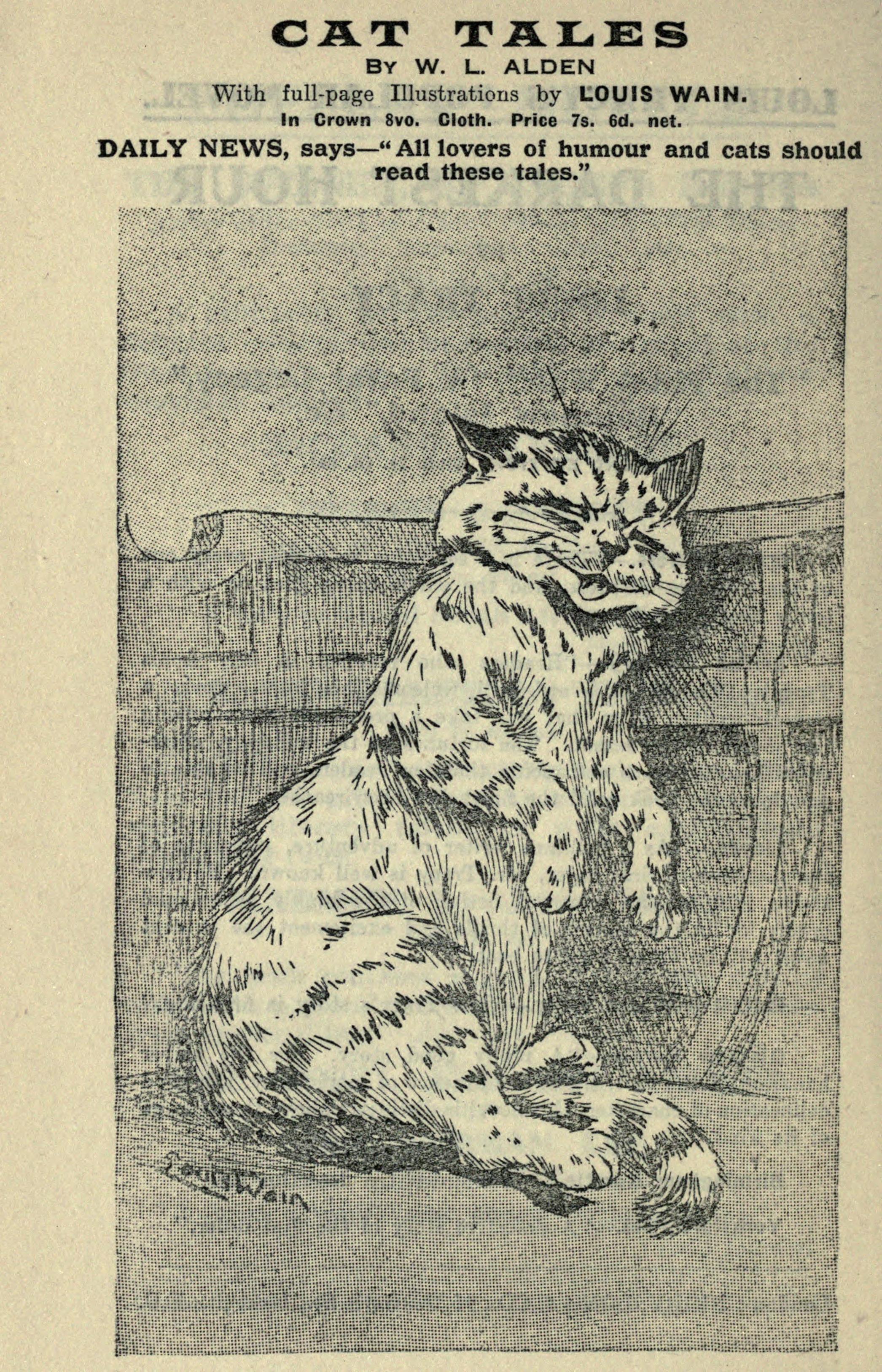
Cat Tales
Wain drew with astonishing speed. According to Collingwood Ingram, he could sketch one of his characteristic cat faces in about 45 seconds. He did not use this talent purely for entertainment: Wain gave public “lightning sketching” performances at schools, dances, and charity events, with the proceeds often going to cat shelters, the Red Cross, and soldiers during the First World War. In 1915, for example, he took part in the charity exhibition Christmas in Wartime at the Royal Albert Hall, where his drawings were auctioned in aid of wartime charities.
Equally curious is the fact that Wain appears to have been highly proficient with both hands. He usually drew with his left, but could switch to his right when the left became tired, and sometimes even produced two different pictures at the same time, one with each hand. Some witnesses claimed that he drew with his left hand but signed his work with his right; Wain could also write in mirror writing.
This very real ability later gave rise to one of the wildest myths about him. In 1931, newspapers circulated a story claiming that throughout his life Wain had drawn charming cats only with his left hand, until one day his right hand suddenly “seized” the pencil and began producing vicious, demonic animals. The article went even further, claiming that this frightened away his clients and ultimately drove him insane, with the two hands practically fighting each other for control of the drawing. Dale flatly dismisses the story as fiction: it is supported neither by doctors nor by medical records, recollections of people who knew Wain, or the surviving artwork itself. We will return to this subject later when examining his medical records.
At the same time, by the early 1920s some of Wain’s acquaintances really were beginning to notice unusual behaviour. One witness who met him at an exhibition in 1921 later recalled that he quickly came to the conclusion that something was wrong with the artist’s mental state. Others who happened to meet Wain between roughly 1918 and 1923 remembered him as a quiet, charming, and generous man, almost always willing to give someone a drawing of a cat, while also remarking that he seemed “a little strange.”
Trip to the United States and the futuristic cats
Wain went to the United States with a rather optimistic plan: he expected to stay for about four months, make a fortune, and return home. In the end, the trip stretched to more than two years. To his own surprise, the artist discovered that he was already well known in America: he got a contract with Hearst newspapers, drew the comics Grimalkin and Cats About Town for them, appeared at cat shows, and was received by the public almost as the world’s most famous painter of cats. The American cat fancy also welcomed him very warmly.
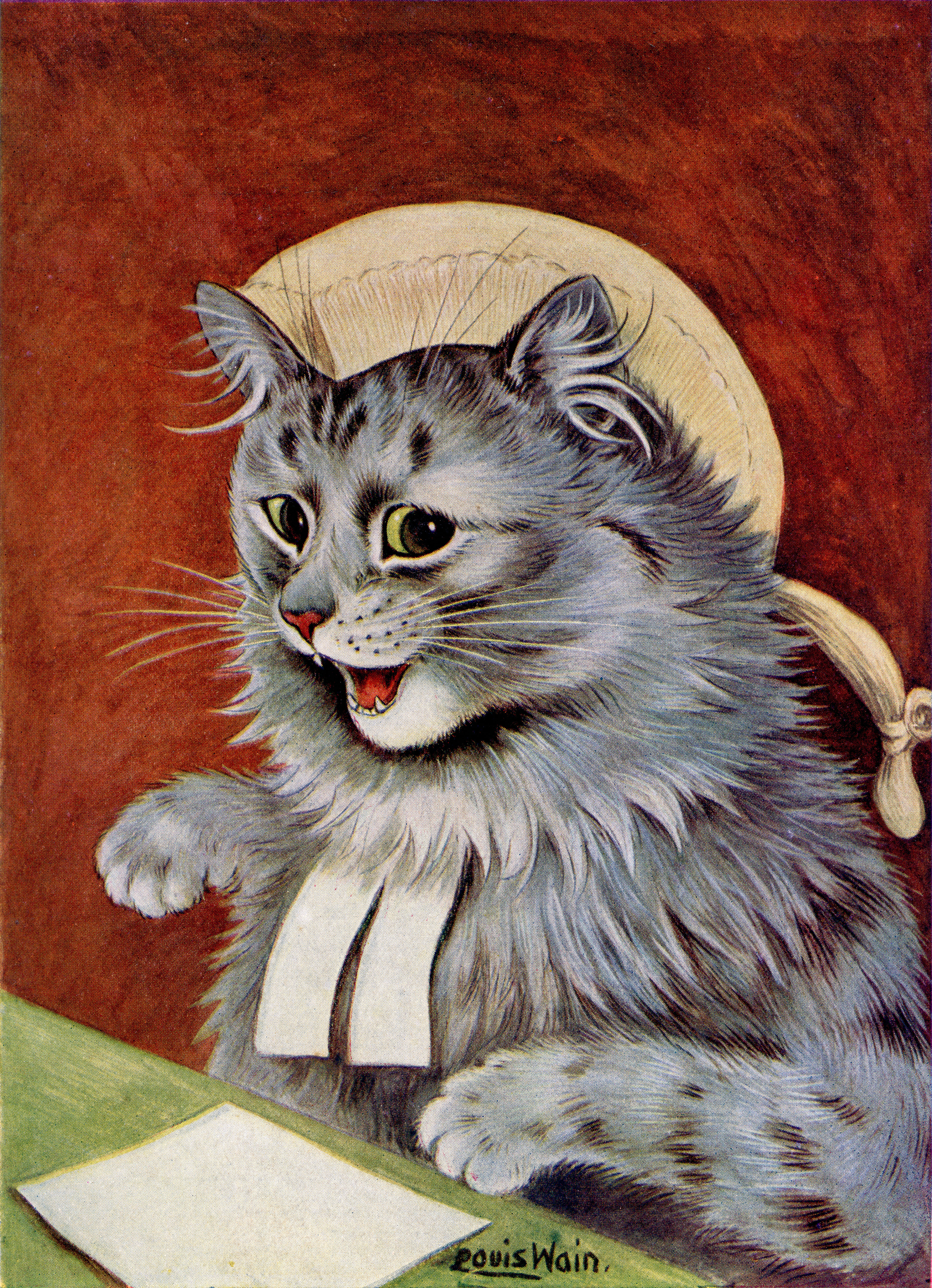
The judge always has his own way
At the same time, America itself was far from entirely to Wain’s liking. In his letters he wrote rather sharply about New York: he was irritated by social inequality, the hard lives of poor immigrants, the cult of money, and what he saw as a lack of tolerance toward foreigners. At times the American press presented these views in an even more caricatured form than Wain’s own words justified, and Dale has to sort out the confusion that grew around one such newspaper retelling.
Toward the end of the trip, Wain’s love of the “physical sciences” got him into trouble once again. He met a man who promised to create some marvelous lamp that would work without oil and revolutionize the market. Wain believed the inventor and, if the later story is correct, invested his savings in the failed scheme. Dale, however, was unable to confirm the story with confidence.
After returning to England, Wain continued to work a great deal, though not without difficulties. In 1914 he embarked on another rather unusual project: a series of ceramic figurines that he called “futurist cats”. They were deliberately grotesque, brightly colored, and partly stylized after cubism, futurism, and Egyptian art; some also functioned as vases or curious good-luck charms.
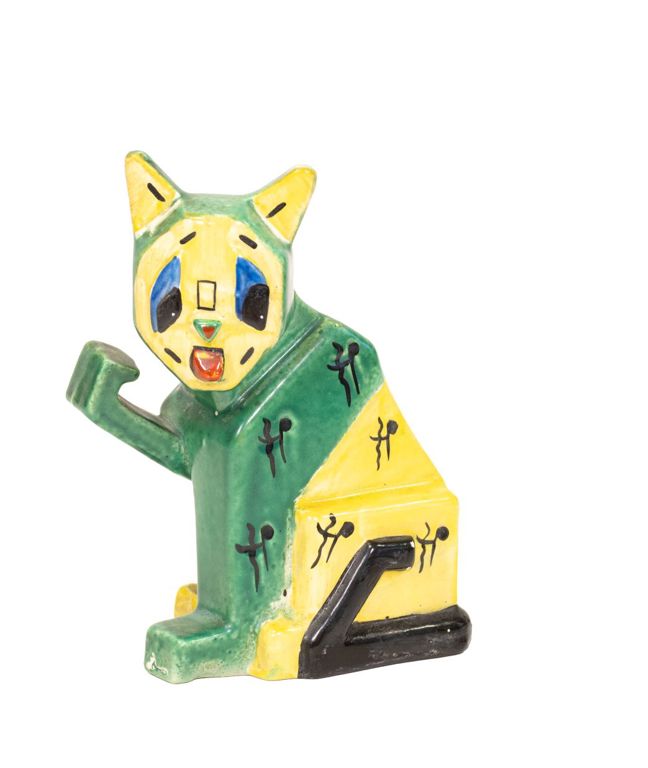
Ceramic cat figurine
There is some confusion about the number of models. Dale writes of nine designs, and old auction catalogs also usually speak of a group of nine produced models. However, a later study of registration records suggests that Max Emanuel registered a total of nineteen designs in May and June 1914 — mostly cats, but also two pigs and a dog. How widely they were actually produced, and how successfully they sold, is much harder to say.
Dale describes the figurines without much enthusiasm and suspects that Wain deliberately made them as provocative and absurd as possible in order to attract attention. For our purposes, however, they are interesting for another reason: well before the First World War, Wain was already quite consciously experimenting with unusual, distorted, and “futuristic” cat images. So the strangeness of his later work does not by itself give us any convenient scale of the artist’s mental condition.
In 1914 several troubles hit Wain at once. According to a story that spread later, a large shipment of his “futurist cats” sent to America was lost when the vessel carrying them was torpedoed by a German submarine. Dale, however, treats the story with caution: he was unable to identify the ship or find convincing confirmation that the episode really happened. I was unable to confirm it either.
Head injury
Another episode is much better documented. On 7 October 1914, Louis Wain fell into the road while boarding an omnibus, struck his head, and lost consciousness. The Times reported the accident: the artist was taken to St Bartholomew’s Hospital with a concussion.
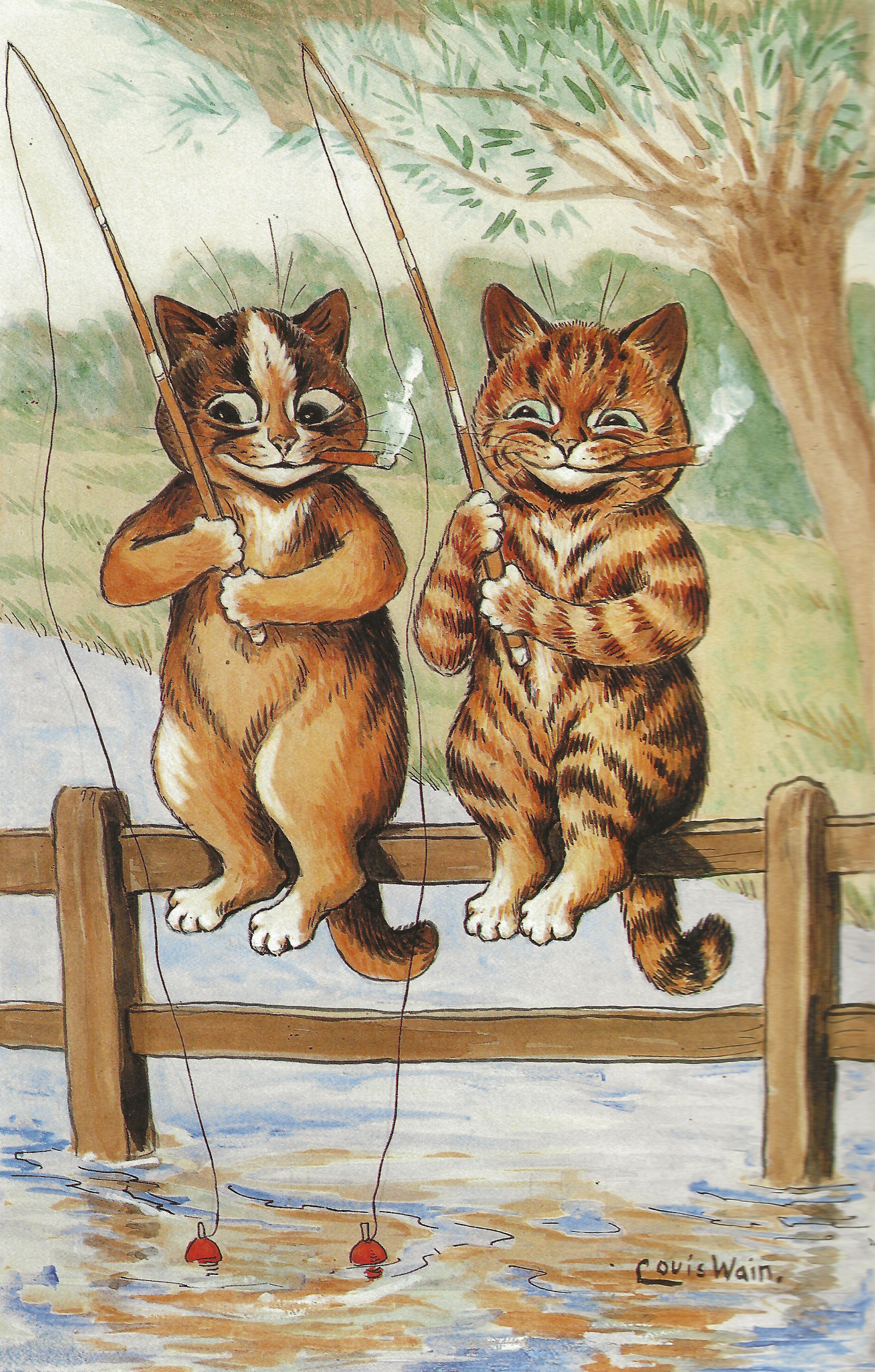
Fishing
A whole legend later grew around the incident. Journalists and later retellings began to claim that the fall from the bus was what caused Wain’s subsequent mental illness. In some versions, the story became even more dramatic: the bus supposedly braked sharply to avoid running over a cat, and when Wain regained consciousness, the first thing he asked was whether the animal was all right. Dale, however, is extremely sceptical of such accounts. He points out that almost ten years passed between the accident and Wain’s admission to a psychiatric hospital: he was not formally certified as mentally ill and hospitalized until 1924.
In other words, the accident was real, but turning it into a simple and convenient explanation for everything that followed is probably unjustified. Moreover, as we will see later, the surviving medical records do not show Wain’s doctors attributing his illness to the injury, and as far as is known, the artist himself did not offer that explanation either.
After leaving the hospital, Wain was advised to rest for at least six months; otherwise, doctors warned him, he risked bringing on a nervous breakdown. In letters, Wain assured friends that he was gradually recovering and trying to follow medical advice, although the enforced inactivity clearly weighed on him. Judging by contemporary recollections, he generally disliked stillness and confinement: an ordinary studio held little appeal for him, and high walls made him feel as though he were in prison.
Financial troubles
Far more significant than a single injury was the general course of Wain’s life during the war years. Westgate, where the family had lived for a long time, became increasingly uneasy as the war continued; demand for Wain’s drawings fell sharply, paper was scarce, and trips to London became too expensive. In 1915, he still managed to file a patent application for his “Rangefinder”, but that did little to improve the overall situation. By the end of 1916, the Wains decided to leave Westgate: the artist’s health was not improving, money was short, and a considerable amount of his time was being consumed by endless attempts to settle debts and reassure creditors.
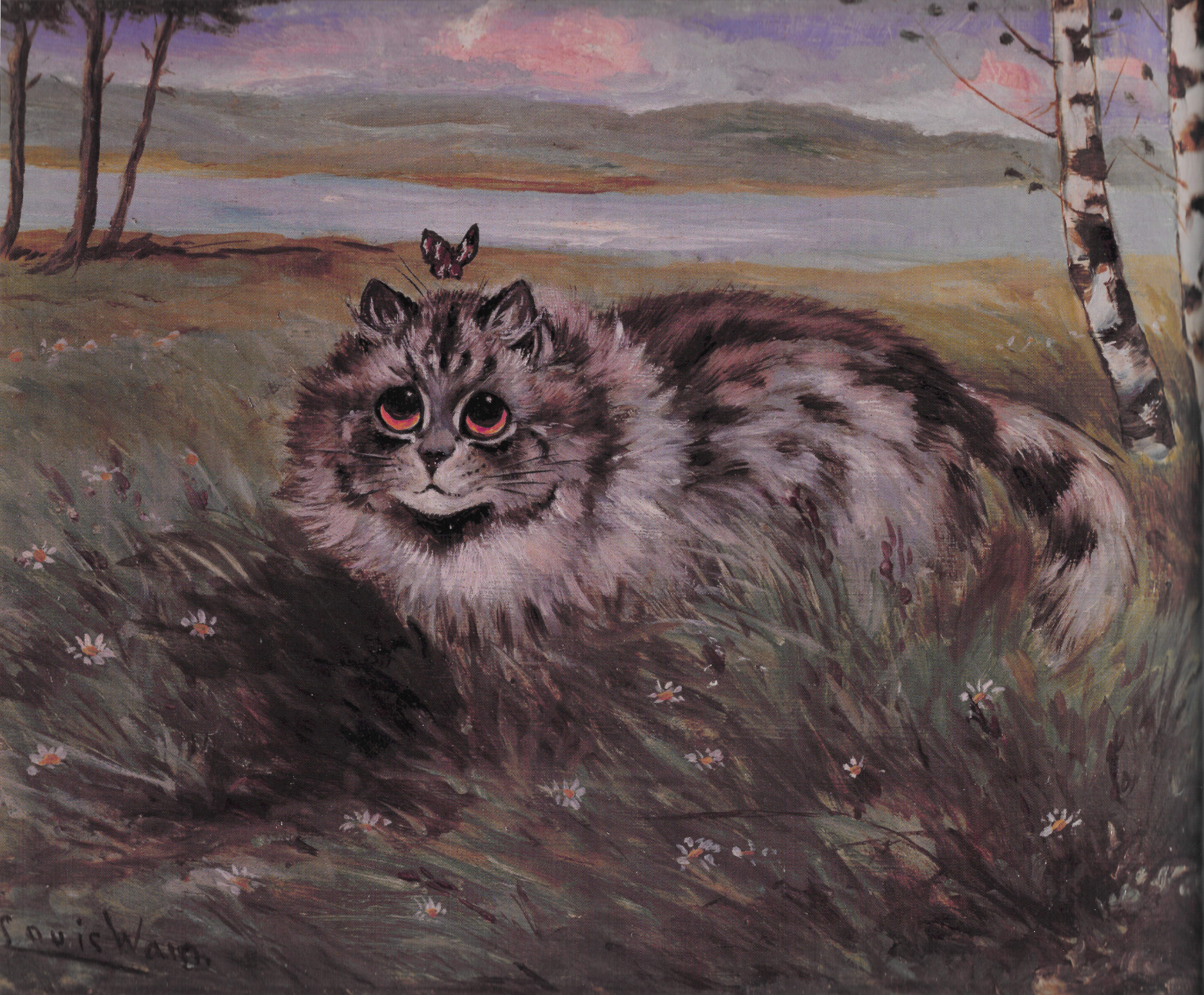
Watching the Butterfly
Money problems became a constant part of Wain’s life during these years. Dale gives several recollections from people whose relatives had dealings with the artist. One official received a drawing from him as a kind of “peace offering” because Wain was unable to pay a bill. On another occasion, Wain paid his dentist by cheque and then immediately asked to borrow enough money for the journey home.
Particularly revealing is the story told by the head of a publishing company. Wain once came to see him the day after receiving a cheque for around £100 and asked to borrow five shillings. To put the absurdity of the situation into perspective, average weekly earnings in Britain around 1915 were roughly £1.2. In other words, £100 represented about a year and a half of average wages, while five shillings amounted to just £0.25. These recollections do not explain where the money disappeared so quickly, but they do make it clear how badly Wain managed his finances and how difficult the situation had become for the family he was still supporting.
Almost everyone who recalled incidents like these, however, spoke of Wain without irritation. Quite the opposite: the same tone appears repeatedly in Dale’s account. People tended to see him as a victim of circumstances, sympathised with him sincerely, and tried to help. The contrast is rather strange — a man whose drawings were known to an enormous audience was sometimes literally paying his bills in cats and borrowing money for the journey back to London.
More generally, various sources repeatedly describe Wain as having no business sense whatsoever, and it seems that some less-than-scrupulous publishers took advantage of this.
The final years before hospitalization

Title unknown
In late 1916 or early 1917, the family moved to a house on Brondesbury Road in London. A few months later came another blow: Louis’s eldest sister, Caroline, fell ill with influenza and died of bronchopneumonia at around the age of 55. Dale believed that her death affected Wain deeply and later became entangled with his increasingly suspicious attitude toward his other sisters.
Despite his financial problems, Wain continued looking for new ways to earn money. In 1917, he even tried his hand at animation. Producer H. F. Wood brought him in to work on short cartoons for Gaumont-British, with George Pearson directing the project. Wain, who was used to producing individual drawings at great speed, struggled to adapt to the need to create large numbers of sequential frames. According to Pearson’s recollections, three or four cartoons were completed, but they were not particularly successful and the project was eventually abandoned.
At least two short films made with Wain’s involvement are known with certainty: The Golfing Cat, whose central character was a cat named Pussyfoot, and The Hunter and the Dog. The films themselves appear to be lost.
After the war, the publisher Valentine & Sons attempted something of a comeback for Wain. He was commissioned to produce a series of four children’s books, followed by several unusual publications with movable elements: when the pages were opened, figures would rise and sway, creating the impression that the illustrated animals’ eyes were moving. The books, however, failed to achieve his earlier success. In 1921, Hutchinson published the final Louis Wain’s Annual. As Dale rather harshly puts it, Wain’s name no longer had the same magic, and his old formula had apparently begun to wear thin with the public.
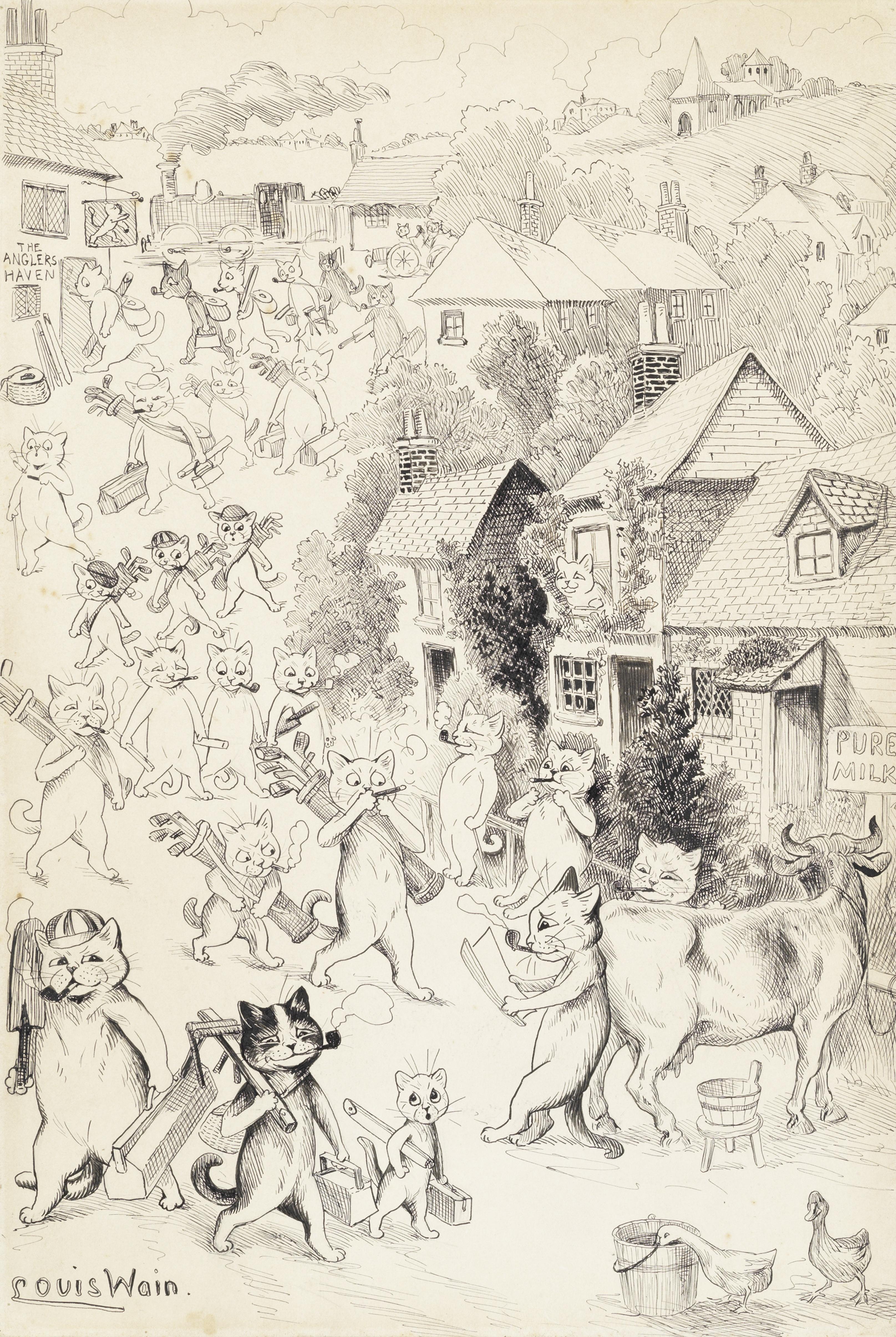
Golfing Cats
Wain himself, however, retained a remarkable confidence in the future almost to the very end. In one of his last letters, written only a few weeks before he was admitted to a psychiatric hospital, he told a friend that he had been through “very hard times,” but that in another two weeks he would supposedly be back on the road to “a far greater career.” In the same letter, he continued offering advice about future articles, asked his correspondent to collect local expressions and describe the lives of working people, and was clearly making a great many new plans.
Dale sees in these late letters an almost desperate sense of urgency, as though Wain were trying to pass on all his ideas before it was too late. But here it is especially important to separate the biographer’s interpretation from the facts themselves. What the letter allows us to say with confidence is simply that immediately before his hospitalization, Wain was still making plans, remained interested in publishing work, and expected a new stage in his career to begin.
Changes in character
At the same time, the people around Wain were beginning to notice much more serious changes. His old reputation as a quiet eccentric probably masked what was happening for quite a while: another unusual idea could easily be dismissed as simply one more Louis Wain oddity. At one point, he began telling well-known figures in the cat fancy about an exhibition at Crystal Palace that he supposedly was organizing himself. In reality, no such exhibition existed by then.
His relationship with his family was becoming even more worrying. Wain began accusing his sisters — Claire, Josephine, and Felicie — of causing Caroline’s death. This is where the familiar image of the eccentric artist gradually begins to change.
By the early 1920s, Wain suspected his sisters of stealing from him, taking his cheques and possessions, while at the same time becoming increasingly absorbed in his electrical and spiritualist theories. This was no longer simply speculation about cats as batteries: Wain claimed that groups of spirits were “projecting currents”, leaving him “filled with electricity”. During the same period, he spent more and more time shut away in his room, writing down his theories.
Gradually, his behaviour began to create very real problems. Wain would spend hours rearranging furniture, sometimes in the middle of the night, could suddenly go out and leave the front door open, and increasingly resisted his sisters’ attempts to stop him. Eventually, there were episodes of violence as well. On one occasion, Louis grabbed Claire by the throat and forced her out of the house; on another, he shoved Josephine hard when she tried to stop him carrying a large picture down the stairs — she narrowly avoided falling by catching hold of the banister. Wain also began sending letters to acquaintances containing accusations against his sisters.
Eventually, the family could no longer cope. Doctors were called in, and on 16 June 1924, following the procedure in force at the time, a reception order was issued for Wain’s admission to a psychiatric hospital. The following day, 17 June, he was admitted to Springfield Hospital in Tooting. The cost of his care was chargeable to Willesden Union — we will look at this first period of hospitalization in more detail below, using the surviving hospital records.
When did the illness begin
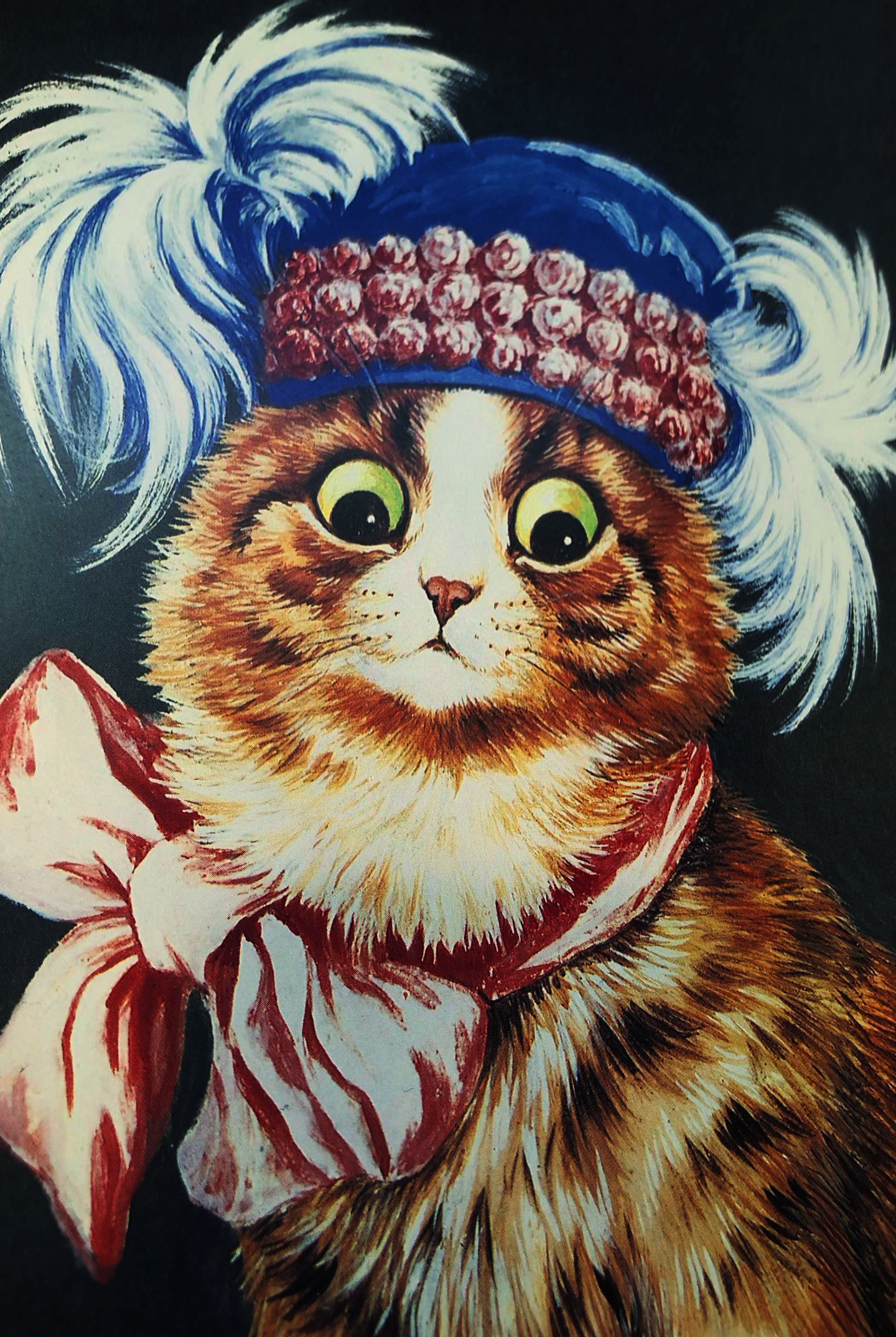
The Feathered Hat
Even Wain’s biographer found it difficult to determine when exactly his condition began to change in a noticeable way. At first, his sisters linked what was happening to the omnibus accident in 1914 and, according to Dale, told the doctors at Springfield about it. Later, however, when Louis was transferred to Bethlem, the family provided another important detail: after the injury he had fully recovered, and the noticeable changes in his character had begun only about two years before his first hospitalization — that is, around 1922.
Wain himself placed the beginning of his strange experiences somewhat earlier. Already at Springfield, he told one of the doctors that certain spirits had been troubling him “day and night for six years”, which, relative to 1924, would push the beginning of such experiences back to about 1918. Dale suggests that there may not actually be a direct contradiction here: unusual beliefs may have appeared earlier, while the changes in his everyday behaviour only became obvious to the family several years later.
We can now add one more piece to the picture: the surviving Springfield admission register. In it, Wain’s case is marked as a first attack (1st attack), which had lasted about twelve months by the time of his admission. If we take that entry literally, the beginning of the current episode was placed around the middle of 1923. So even the documents and recollections from the time do not give us a single exact date: Wain himself pointed roughly to 1918, the family to about 1922, and the Springfield register to approximately 1923.
Perhaps the simplest explanation is that these sources were talking about different things: the first unusual experiences, the character changes visible to other people, and the beginning of the condition that doctors already considered the current attack of illness. So it probably makes little sense to search for one exact date after which Wain suddenly “became ill”. This picture broadly matches what we have already seen in the recollections of people who knew him: from the late 1910s into the early 1920s, Wain increasingly gave the impression of being not merely eccentric, but clearly unusual. At the same time, the 1914 accident can hardly explain everything that followed.
Patricia Allderidge cautiously notes that the deterioration seems to have begun during the First World War, when the family was gradually becoming poorer and sinking into debt. How much that difficult financial situation affected the artist’s health is now impossible to determine.
Despite all this, Wain continued to draw at Springfield. He still accused his sisters of mistreating him, spoke about the electrical force contained within him, and even claimed to possess certain healing abilities. At the same time, life in the hospital did not in itself turn him into a helpless person: according to staff recollections, he had not lost his artistic skill and soon resumed working on drawings constantly. His sisters regularly brought him pencils and sketchbooks, and took finished works away with them.
According to Dale, Wain even absconded from the hospital one day in August, boarded a tram, and rode away, after which he had to be brought back.
Documents from Springfield
To learn more about the first period of Wain’s hospitalization, we contacted The London Archives, which holds the records of Springfield Hospital under the reference H46/SP. No individual case file comparable to the surviving Bethlem material could be found: Wain’s name does not appear among the available case papers in series H46/SP/B/09/002.
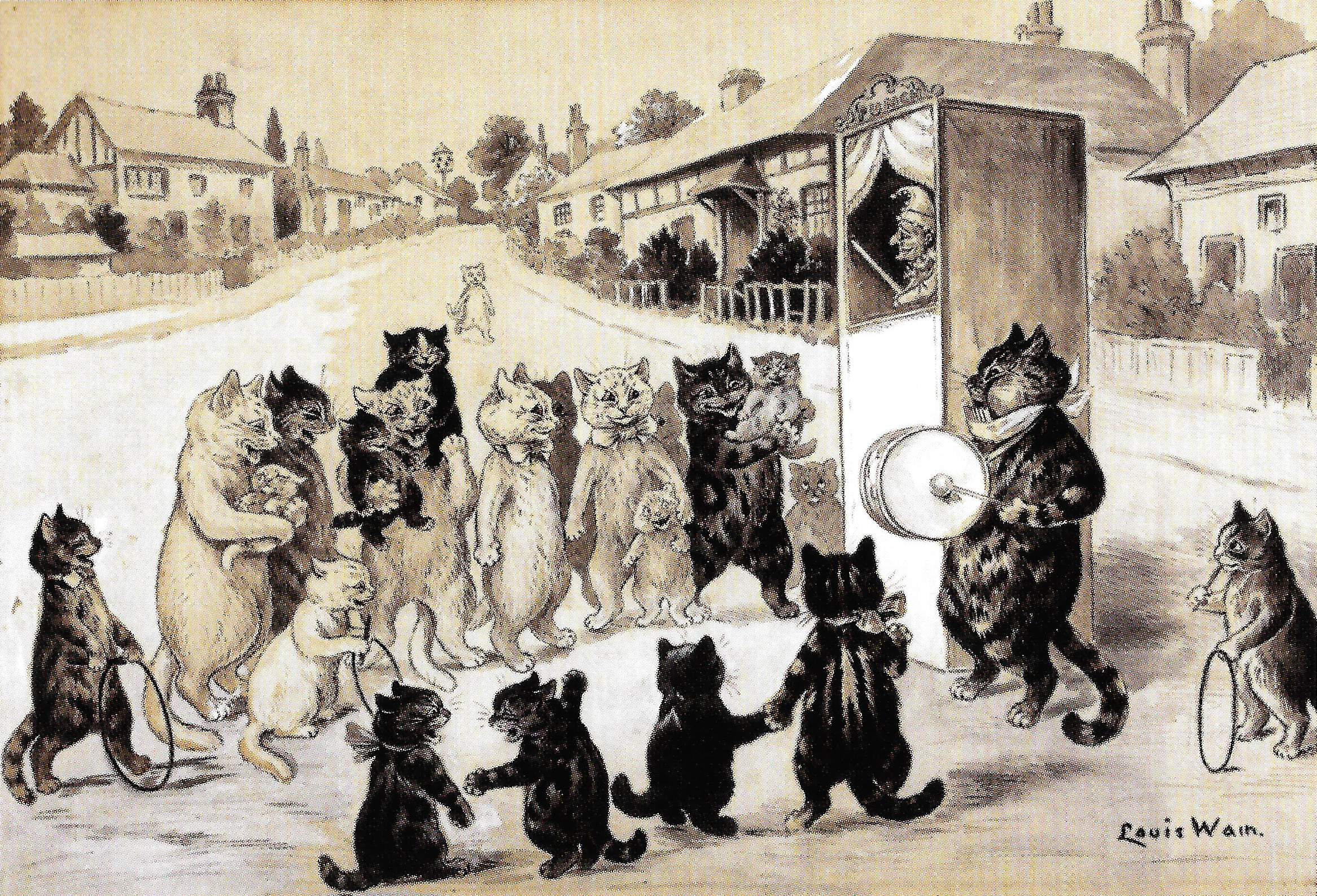
The Punch and Judy Show
At our request, the archivist checked several other registers covering 1924–1925. The medical journal H46/SP/B/05/014 turned out to deal mainly with physical illnesses, injuries, and incidents. Wain is not mentioned anywhere from June 1924 to the end of the volume.
Nor does he appear in the Register of Special Reports and Certificates (H46/SP/B/01/219). Despite its stated date range of 1889–1948, the register itself was only compiled from the late 1930s onward, so earlier patients were included only if they were still at Springfield at that time.
Wain does, however, appear in several registration books. Together, they confirm his admission on 17 June 1924, his transfer to Bethlem Royal Hospital on 24 August 1925, patient number 6272, and the notation not improved at the time of transfer. The Admission Register also states that his current attack had lasted for about a year by the time he was admitted.
The archivist also checked the Register of Discharges or Absent on Trial Period (H46/SP/B/02/041), but Wain does not appear there, which makes perfect sense: he was neither discharged nor released on trial, but transferred to another hospital.
Below, we will take a closer look at the three surviving entries for which I was able to obtain digital copies from the archive.
Admission register
So, in front of me is Springfield Hospital’s admission register. Louis Wain appears in neat handwriting under patient number 6272, with the following details:
Age — 63. This matches the known date of Wain’s birth exactly.
Diagnosis — Del. Insanity. This appears to be an abbreviation of delusional insanity, a historical diagnostic term that can be translated approximately as a disorder characterised by delusions.
Date of admission — 17 June 1924. This was the day after the reception order authorising his admission had been issued.
Presumed associated factor — D3. This was a code from the classification then used for causes and associated factors in mental disorders;
D3stood for senility, or old age. This notation should not be understood as an established cause of Wain’s illness in the modern medical sense. Rather, it was a factor that doctors of the period considered relevant when classifying the case.Number of attack — 1st. In other words, this episode was recorded as the first manifestation of the illness.
Duration of attack — 12 mos. At the time of admission, the current condition was considered to have lasted for about twelve months. This places the approximate beginning of the episode around the middle of 1923, although it should certainly not be treated as the precise moment when the first symptoms appeared.
Date of removal — 24 August 1925. This appears in the Removed column. From another register, we know that this was not a discharge home: on that date, Wain was transferred from Springfield to Bethlem Royal Hospital.
Even this rather concise entry therefore adds several important details. Wain’s case was recorded as the first attack of the illness, already lasting about a year by the time of admission, and after a little over fourteen months he was not discharged but transferred to another psychiatric hospital.
Civil register
The next document is Springfield Hospital’s civil register. It is mainly administrative in nature, but it helps clarify several details about Wain’s life immediately before his hospitalization and the procedure by which he was admitted.
The following details can be made out in Louis Wain’s entry under number 6272:
The reception order was issued on 16 June 1924, and Wain was admitted to Springfield the following day, 17 June.
The admission is recorded as direct: Wain was not transferred from another medical institution.
His usual place of residence is given as 41 Brondesbury Road, NW6. He was brought to the hospital from the same address. This was therefore Wain’s residence immediately before his hospitalization.
His marital status is given as widowed, which matches the known biographical record.
Age — 63.
Religion is abbreviated as R.C., meaning Roman Catholic.
Under previous occupation, Wain is described as an artist, animal painter, and cartoonist (Artist / Animal / Cartoonist).
The cost of his maintenance was chargeable to Willesden Parish. This is consistent with another register, which refers to Willesden Union.
The two medical certificates on which Wain’s admission was based are both dated 16 June 1924. The names of the doctors who signed them cannot be read with complete confidence, so I will not reproduce them here.
In May 1925, the order authorising Wain’s continued detention was formally renewed.
On 24 August 1925, he was transferred to another hospital. An additional entry appears under Transferred — Not Improved, meaning that no improvement in his condition had been recorded by the time of transfer.
Campaign for Wain and transfer to Bethlem
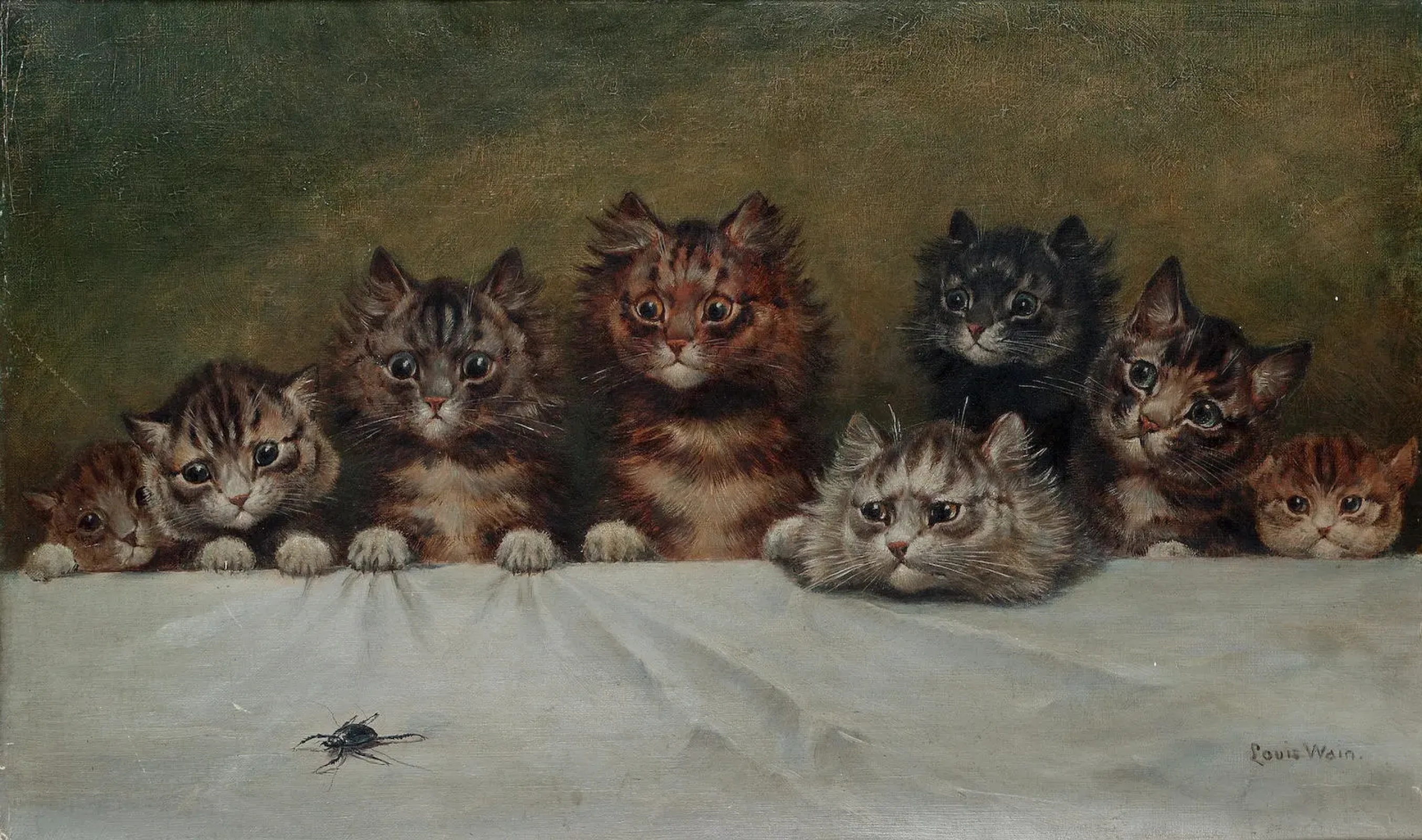
In All Eyes!
Wain’s sisters continued to visit him at Springfield almost every week. They brought him treats, supplied Louis with sketchbooks and crayons, and took his new drawings home after their visits — unless, of course, he had already given them away to people around him. Wain readily talked to visitors and sometimes entertained children with stories about animals and quick sketches. The popular version in which his sisters simply “dumped” an inconvenient relative in an asylum and forgot about him is therefore, at the very least, difficult to reconcile with what they did afterwards.
The turning point came almost by accident in 1925. During one of the regular inspections of Springfield Hospital, bookseller and public visitor Dan Ryder noticed a quiet man drawing cats. Looking at his work, he exclaimed, “Good God, you draw like Louis Wain!” The patient calmly replied, “I am Louis Wain.” Ryder did not believe him at first, but soon realised that the famous artist really was at Springfield as a pauper patient whose care was being paid for from public funds.
Ryder contacted Ada Elizabeth Chesterton, also known as Mrs Cecil Chesterton, and before long a special committee was formed, followed in early August 1925 by the creation of a Louis Wain fund. Journalists, artists, animal lovers, and people who had grown up with his drawings joined the campaign. The press wrote with surprise that an artist who had once been enormously popular had ended up virtually penniless. The organisers initially hoped to raise £1,000; according to Dale, around £275 had been contributed by 18 August.
The campaign also attracted the attention of prominent public figures. Former Prime Minister and then Leader of the Opposition Ramsay MacDonald spoke in support of it, writing that fifteen or twenty years earlier Wain’s drawings had been seen almost everywhere and that hardly any other artist had given so much pleasure to children. The campaign was also supported by the serving Prime Minister, Stanley Baldwin. On 24 August 1925, Wain was transferred to Bethlem Royal Hospital.
Curiously, both Dale and Allderidge refer to MacDonald as Prime Minister when discussing the events of 1925. This is an error: MacDonald had left office in November 1924, and by the time of the campaign the government was headed by Stanley Baldwin.
The story attracted so much attention that even H. G. Wells spoke out in support of Wain. On 27 August, a radio address by Robert Loraine included a message written by Wells, who remarked that Wain had effectively created his own “cat style, cat society, and an entire cat world”, and that English cats which did not resemble Wain’s characters ought to be ashamed of themselves. The wording is playful, but it gives a good sense of just how famous Wain had once been.
Discharge and transfer register
The final Springfield document is the register of patient discharges and transfers. Wain’s entry here is extremely brief, but important for understanding how his first period of hospitalization ended.

The Naughty Puss
The register states that Louis Wain was admitted to Springfield on 17 June 1924 and transferred to Bethlem Royal Hospital on 24 August 1925. His civil register number is again given as 6272.
On the second half of the spread, there is an entry under Transferred — Not Improved. In other words, Wain was not discharged but transferred to another institution, with no improvement in his condition recorded at the time. The register once again states that the cost of his maintenance was chargeable to Willesden Union.
Interestingly, most of the medical and statistical columns in this register were left blank for Wain. The reason is stated directly in the table heading: these details were completed only for patients who had been discharged recovered.
The document therefore gives us a clear end point for Wain’s stay at Springfield: a little over a year after his admission, no improvement had been recorded, and on 24 August 1925 his treatment continued at Bethlem Royal Hospital.
Life at Bethlem
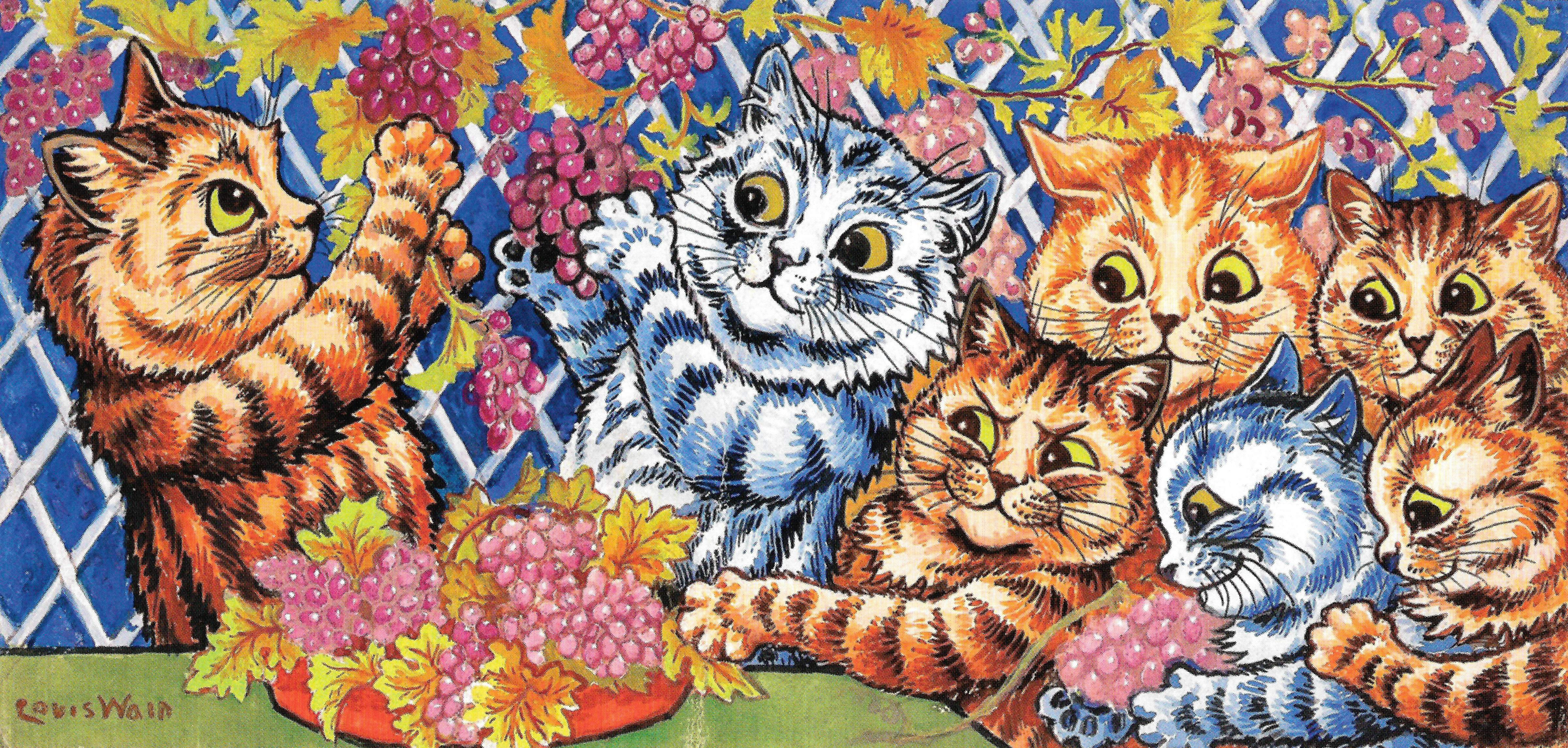
In the Vineyard
In August 1925, Louis Wain was transferred from Springfield Hospital to Bethlem Royal Hospital. Conditions there were considerably better. Wain was given his own room and continued to draw. Despite his persistent unusual beliefs about electricity, spirits, and healing powers, he was generally calm and sociable in everyday life. Staff noted that his artistic abilities remained intact: he continued to draw cats, but also produced fantastical landscapes and architectural compositions.
His characteristic sense of humour survived as well. Dale tells a story in which Wain once took a German novel from another patient and gave him a Greek New Testament in exchange. When the other man objected that he could not read Greek, Wain replied that he could not read German either — so they were even.
The 1925 campaign effectively reintroduced Wain to the British public. An exhibition of his work was organised, while the fund established in his support attracted substantial donations.
By this point, however, Wain himself was not the only one who needed help. His three surviving sisters — Claire, Josephine, and Felicie — were also living in very difficult circumstances. They tried to preserve the house on Brondesbury Road as Louis remembered it, but money was constantly short. According to Dale, they had to sell paintings and jewellery just to make ends meet. Following the renewed public interest, the fund began helping the sisters as well, and Ramsay MacDonald later assisted in securing them a small pension in recognition of their brother’s contribution to British art.
Wain remained at Bethlem for almost five years. In 1930, the hospital was preparing to move to new premises, and Louis was transferred to Napsbury Hospital near St Albans. It stood among extensive gardens and trees, and judging by later accounts, Wain settled in there fairly quickly. He would spend the remaining years of his life at Napsbury.
Before moving on to this final period of his biography, however, let us look at what the surviving Bethlem medical records tell us about Wain’s condition during those five years.
The Bethlem case record
General information
So, in front of me is a copy of Louis Wain’s medical record from Bethlem’s official casebook for 1925 (CB-216). The entry was opened on 24 August — the day he was transferred from Springfield Hospital.
The brief summary on the first page gives the following information:
Age: 64. This is what the record says, although according to Wain’s generally accepted date of birth, he had already turned 65 by that point.
Marital status: widower.
Occupation: artist.
Religion: Roman Catholic.
Age at first attack: 63.
Duration of present attack: 2 years 2 months.
Previous place of treatment: Springfield Hospital, from 16 June 1924 to 24 August 1925. Curiously, Springfield’s own admission register gives 17 June as the date of admission; the reception order was issued on the 16th.
Supposed cause of the mental disorder: unknown. Note that the earlier concussion is listed separately below under injuries.
Relatives with mental illness: unknown. At first glance, this seems strange given Marie’s hospitalization, although this little mystery will be resolved later.
Suicidal tendencies: none.
Danger to others: violence toward a sister is noted.
Injuries: a concussion is mentioned; the rest of the note is difficult to read.
Children: none.
Diagnosis: paraphrenia. Paraphrenia, specifically, rather than schizophrenia — we will return to that distinction later.
Prognosis: the entry cannot be read with confidence. The first word is probably poor.
Even this brief summary gives us several interesting details. First, the medical record is not entirely consistent even within itself. Wain’s recorded age does not match his known date of birth, while the age given for his first attack does not line up perfectly with the stated duration of the illness. Counting back two years and two months from August 1925 would place the beginning of the present attack around June 1923, when Wain was still 62. Clearly, these figures are better treated as an approximate history recorded on admission than as a way of dating the onset of the illness with precision.
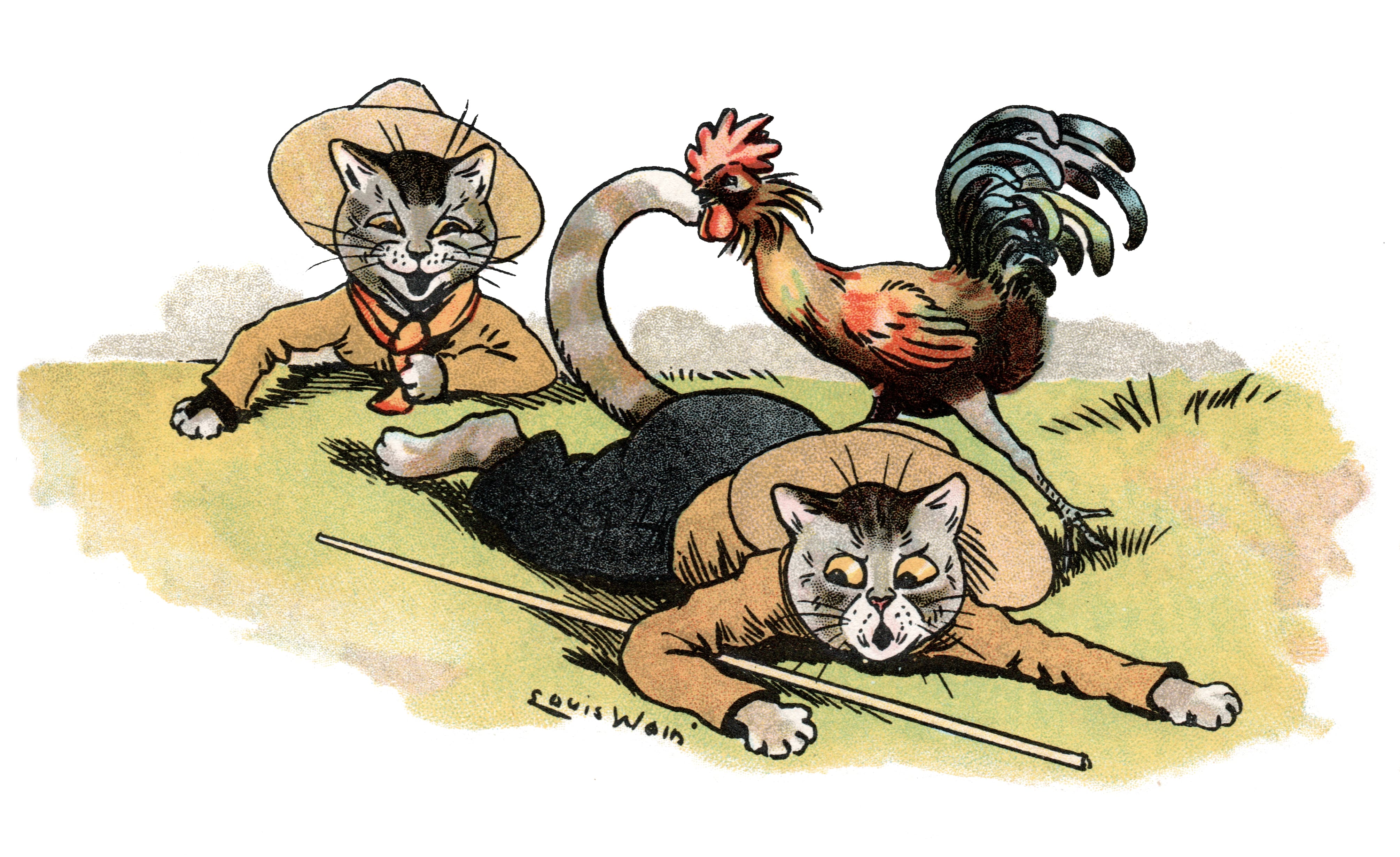
A Peck of Troubles
Second, the field dealing with the supposed cause of the illness is particularly interesting. Despite the well-known head injury of 1914, Bethlem’s doctors did not record it here as the cause of Wain’s mental disorder: the relevant field simply says “unknown”. The concussion itself is mentioned separately among his previous injuries. This does not, of course, mean that the doctors had specifically ruled out any connection between the two events, but it certainly does not support the later simplified legend in which Wain’s medical history can be reduced to “fell off a bus — went mad”.
Finally, the diagnosis written in the record is paraphrenia. That is the word actually used in the document; the much better-known diagnosis of “schizophrenia”, which later came to be attributed to Wain almost automatically, does not appear on the first page of his case record.
Testimonies
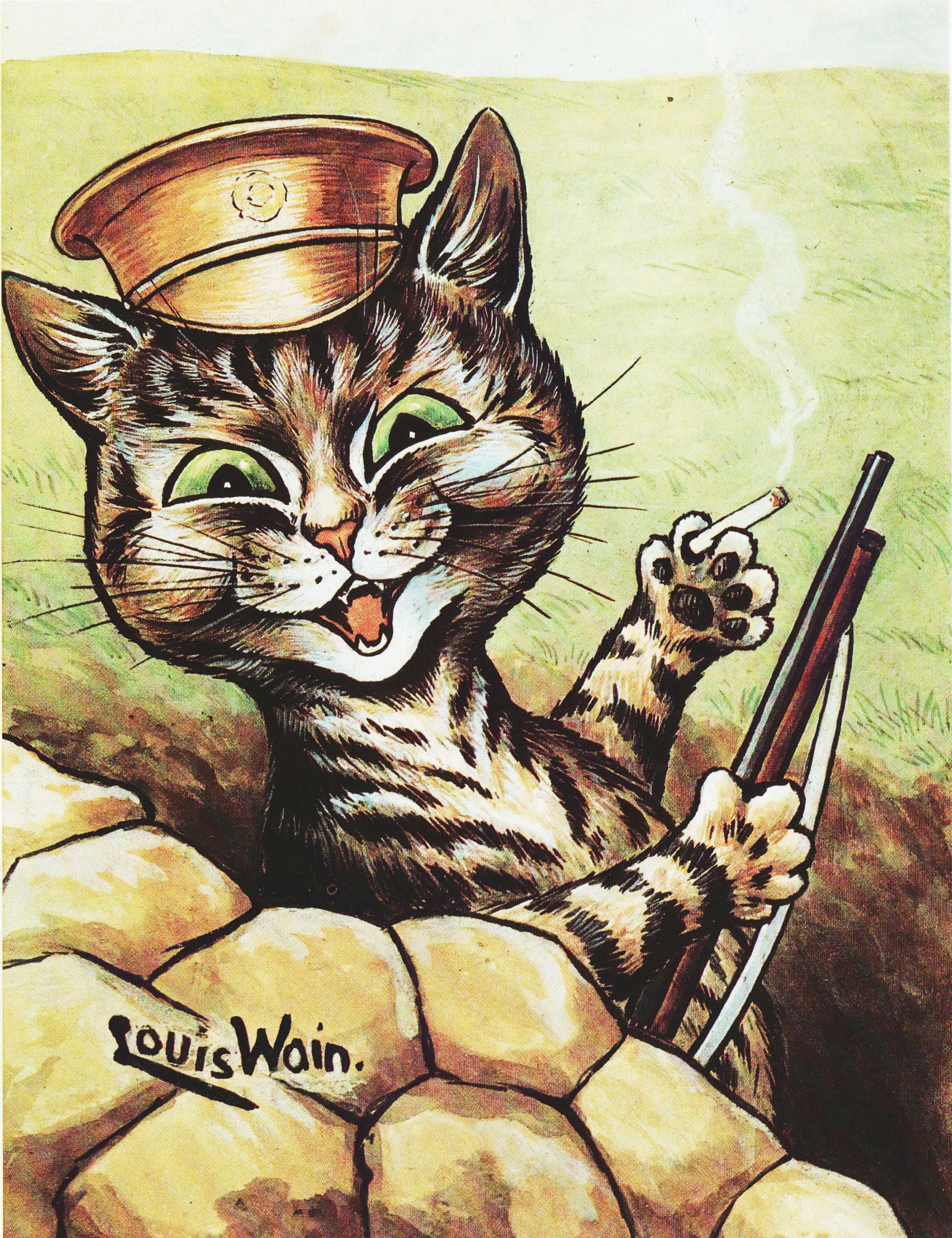
Entrenched
The case record also preserves the statements on which Wain’s original medical certification was based. These are particularly valuable because they allow us to see what the doctors themselves observed and what was reported to them by Wain’s relatives and acquaintances.
Dr John Spinway, of 74 Brondesbury Road, recorded the following under Facts indicating insanity observed by myself at the time of examination:
He says “There are gangs of spirits going about projecting currents”. Says his sister (Claire) robs him, takes his cheques, steals things and ought to go to prison. He has been bothered by spirits night and day for six years.
This is one of the clearest surviving descriptions of Wain’s unusual beliefs at the time. He spoke of “gangs of spirits” that were “projecting currents” and claimed that they had troubled him continuously for six years. At the same time, he accused Claire of stealing his cheques and possessions and insisted that she ought to be sent to prison.
Spinway then recorded information supplied by other people. Mrs S. Hutchings, identified as a friend, reported that Wain:
Writes irresponsible letters.
The doctor added that he had personally read two such letters, written to Mr S. Hutchings of 38 Brondesbury Road, NW6.
Claire Wain reported both suspicious behaviour and violence. According to the certificate, Louis:
Accused his sister (Claire Wain …) of stealing, and has been guilty of acts of violence to her. He is collecting and secreting all the scrap of metal which he can find.
A second medical certificate was completed by Dr J. Anderson Smith of 158 Willesden Lane. His own observations were strikingly similar:
Says his sisters are out of their minds, says they have been taking his cheques and therefore he had to lock everything up — thinks the flickering of the cinema has taken the electricity out of his sisters’ brains.
The reference to the cinema is particularly curious. Wain apparently believed that its flickering had somehow removed the “electricity” from his sisters’ brains — another example of electrical ideas, which had interested him for decades, appearing here in a very different form.
Josephine Wain told the doctor that Louis:
locks himself up in his room — accuses her of selling his things — writes letters to all sorts of people, accuses his sisters of robbery.
Claire’s second statement describes the most serious incident:
took her by the throat and put her out of the house in a fit of temper — has changed from a mild tempered man to an obstinate violent man.
These certificates therefore give us something more precise than the later biographical summaries. The doctors recorded Wain’s beliefs about spirits, electrical currents, theft, and the condition of his sisters directly, while his relatives described a marked change in behaviour: locking himself away, hiding scrap metal, sending accusatory letters, and, on at least one occasion, physically attacking Claire.
Patricia Allderidge also notes that some of the surviving accounts of Wain’s letters support this picture: in letters sent to acquaintances, he did indeed speak harshly about his sisters.
Family and previous history
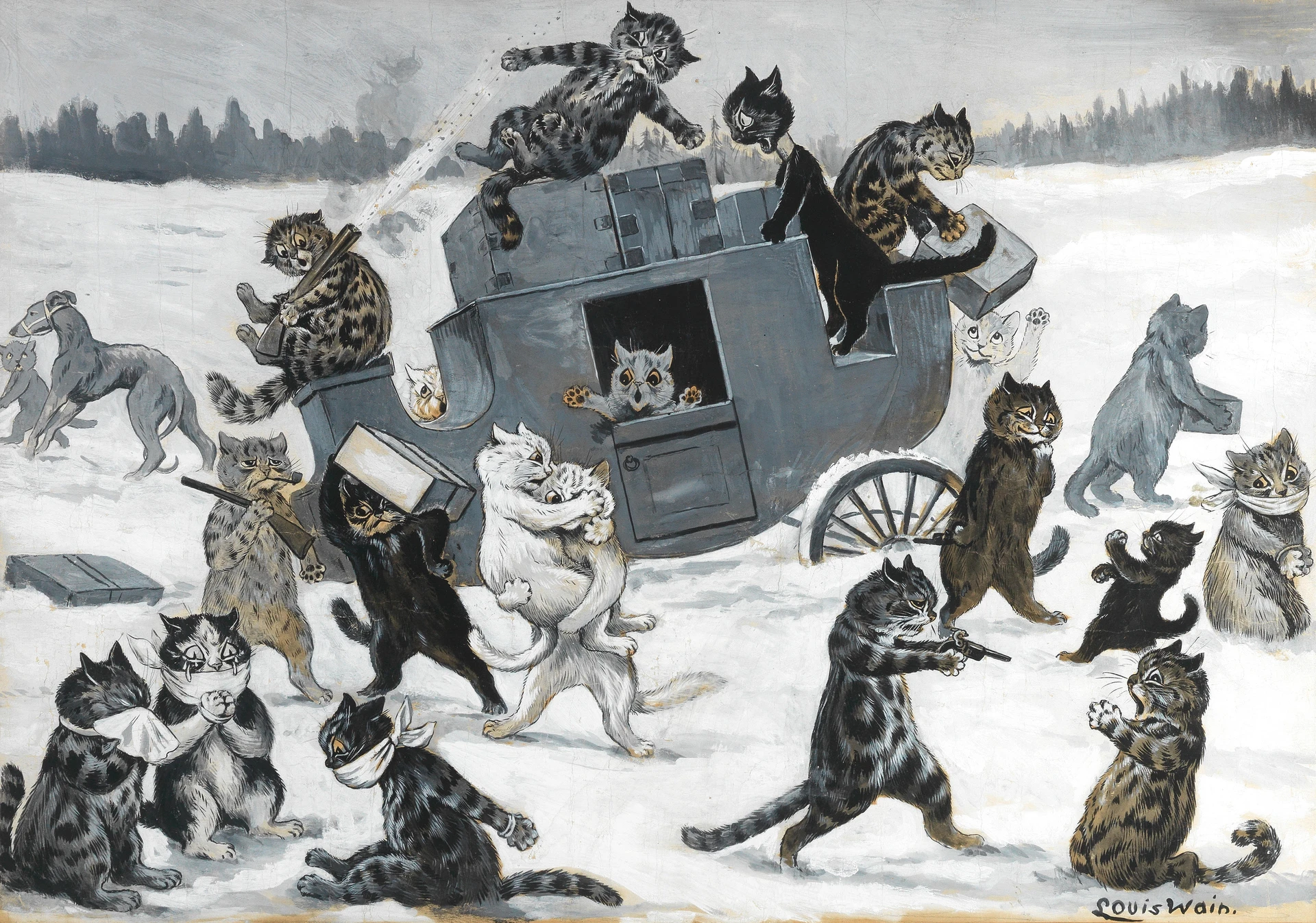
A Highway Robbery
The next section of the case record deals with Wain’s family history. A sister is explicitly named as the source of the information, although it is not stated which one.
The beginning of the entry cannot be deciphered in full. The doctor says something about Louis’s father’s background and notes that his mother had artistic inclinations; the family as a whole is then described as having “gone in for art”. This is not far from the truth: Patricia Allderidge, for example, notes that two of Wain’s sisters were accomplished artists. The record also mentions that the family had once been well off but later suffered a financial collapse.
The following passage is particularly interesting:
One sister was admitted to a mental hospital suffering from melancholia. No other cases of confinement in mental hospitals are recorded in the family.
The sister is not named, but this almost certainly refers to Marie Wain, who, according to the biographical evidence, spent many years in a psychiatric institution.
This finally resolves the oddity on the first page of the case record. In the initial summary, the field concerning mental illness among Wain’s relatives was effectively marked “unknown”, whereas a few pages later the more detailed family history explicitly records the hospitalization of one of his sisters. Perhaps the summary was completed before a fuller family history had been obtained and was simply never corrected. In any case, even within the same medical record, the brief summary and the more detailed history do not entirely agree.
The final line of the family section is much harder to read. The doctor appears to note certain characteristics of three of the sisters, perhaps connected with their artistic temperament or eccentricity, but I have not been able to reconstruct the wording with confidence.
The record then turns to Wain’s own previous history. His usual temperament is described with a single word — reserved. According to the entry, he did not drink alcohol at all, and there was no history of seizures.
The accident of 1914 is mentioned once again. Wain suffered a concussion and remained under medical observation, but the case record explicitly states that he made a complete recovery and remained well until roughly two years before his admission to Bethlem. This once again fits poorly with the later version in which the 1914 injury itself directly caused his mental illness.
In the section dealing with previous attacks, the record states that roughly three years before admission — around 1922 — Wain began writing almost continuously. Some of these writings were, in the doctor’s opinion, nonsensical. Allderidge, who appears to have had access to these records, likewise notes that much of Wain’s writing seemed fairly meaningless, although it would occasionally contain unexpectedly beautiful poetic passages.
Louis then began refusing to go to bed, reacted strongly when others tried to interfere with him, and at times became aggressive. At the same time, the suspiciousness we have already encountered grew more pronounced: Wain increasingly believed that people were stealing his possessions.
Doctors’ observations
First observation

Early Greek
The case record now moves on to dated medical notes — essentially brief observations of Wain’s condition at different points during his stay at Bethlem.
The first is dated 31 August 1925, about a week after his admission. The doctor again gives Wain’s age as 64 and describes certain “peculiarities of voice, manner and dress”. At the same time, the entry suggests that this eccentricity was not itself regarded as something new. As far as the handwriting can be deciphered, people had long considered Wain somewhat unusual, but had not regarded these traits as signs of illness. He was not particularly sociable and had no business sense whatsoever.
The doctor then tries to identify the beginning of more serious changes. The 1914 accident is mentioned once again, followed by the war and the sharp decline in demand for Wain’s work. His character gradually changed: he became suspicious and irritable, and later developed delusions of persecution. The record also notes that before his transfer to Bethlem, Wain had been at Springfield Hospital, where these symptoms became more pronounced.
The next part is considerably harder to read. What is clear, however, is that after his arrival at Bethlem Wain continued to draw and remained deeply absorbed in his own theories. The doctor also notes that the atmosphere of the hospital and the complete change of surroundings seemed to have a stimulating effect on him. His use of colour is specifically mentioned, although I have not been able to reconstruct the exact wording of this passage.
The doctor sums up Wain’s condition rather briefly: he remained a man with fanciful delusions, while his physical condition was considered good for his age.
This entry is particularly interesting because the doctor seems to draw a fairly clear distinction between Wain’s longstanding eccentricity and the later changes in his condition. His unusual manner, reserved personality, and complete lack of business sense are described more as features of his earlier character, whereas suspiciousness, irritability, and persecutory delusions belong to the later period.
Moreover, only a week after his admission, the doctor describes no general collapse of Wain’s creative abilities. On the contrary, he continued to work, and in the doctor’s view the new environment may even have stimulated his creativity.
Subsequent entries
The later entries are rather repetitive, but interesting precisely because of that repetition: over the following months, the doctors repeatedly noted that Wain’s condition remained essentially unchanged.
One of the first notes reads:
“There is no change to record in patient’s condition. He is quite occupied in his work and has his delusions still remaining the same.”
On 4 September 1925, a much more important entry appears:
“Patient’s condition has not changed at all. Still very delusional. He keeps himself busy with his paintings; he seems to have lost none of his technique.”
The next brief notes again say essentially the same thing: “There’s no change.”
On 20 November 1925, the doctor writes:
“On talking to patient there seems little alteration from the above description and notes. He is still drawing and still has delusions of a divine/god nature — he is still suspicious.”
The phrase describing the nature of these delusions is difficult to read with complete confidence, hence the alternative reading divine/god.
On 20 December:
“No change in patient’s condition; seems quite contented with his lot.”
And on 14 February 1926:
“No change. Patient is contented and occupied but very deluded.”
A much fuller entry appears on 17 September 1926:
“General condition unchanged. His delusional system is as prominent as ever. It is almost impossible to get him to talk about anything else. He has been allowed out for some visits with an attendant in the past, is very anxious to go again, but this has been refused owing to his attempts to converse in his own way with strangers. He keeps busily occupied with his painting, which seems to be somewhat cruder & sometimes more bizarre than his earlier work. His physical condition is satisfactory.”

A Kitten Line
This entry is particularly interesting for two reasons. First, Wain’s delusional system remained so prominent that, according to the doctor, it was almost impossible to get him to speak about anything else. Second, the note records that he had previously been allowed outside the hospital with an attendant and was eager to go again, but further outings were refused after his attempts to “converse in his own way with strangers.” What exactly the doctor meant by that phrase is not explained.
The same entry also contains the first clearly critical assessment of Wain’s later art. A year earlier, the doctor had written that he “seems to have lost none of his technique.” Now his painting was described as “somewhat cruder & sometimes more bizarre than his earlier work.”
This is certainly evidence that at least one doctor noticed a change in Wain’s style. But it is still a subjective judgement rather than evidence of any measurable collapse in artistic ability. The same note explicitly says that Wain remained “busily occupied” with painting, and nowhere does it suggest that he had lost the ability to draw.
Final entries

By The Fire
An unusual episode appears in the record on 3 September 1927. Unfortunately, the final line remains undeciphered, but most of the entry can be read:
“Patient to-day was very unusually restless & upset to the Staff. At a time of mild excitement in the ward he resisted M.A.s & became aggressive. His suspicion of poisoning. He was very excited & apprehensive.”
The exact details of the incident are not entirely clear, but the overall picture is: Wain was unusually restless and upset, resisted members of staff during a period of mild excitement on the ward, became aggressive, and expressed suspicions of poisoning. The doctor described him as “very excited & apprehensive.”
Only a month later, on 3 October 1927, the tone is completely different:
“He has settled down again & is doing some good painting.”
And on 3 November:
“He continues satisfactorily.”
After this, the medical record becomes almost completely repetitive. Over the following years, the doctors left around thirty short notes, most of them simply recording that there had been no change.
The final such entry, dated 19 April 1930, reads:
“no change”
Soon afterwards comes the administrative note recording Wain’s transfer to Napsbury Hospital. On 30 May 1930, he left Bethlem and was transferred to Napsbury, where he would spend the remaining years of his life.
Taken as a whole, nearly five years of Bethlem records do not show any simple pattern of continuous deterioration. Wain’s delusional beliefs persisted, and there were occasional episodes of marked excitement and aggression, but between them his condition remained remarkably stable for long periods. Throughout these years he continued to paint. In 1925, a doctor wrote that he “seems to have lost none of his technique”; in 1926, another note described some of his work as “somewhat cruder & sometimes more bizarre”; and after the disturbed episode of September 1927, the very next month he was once again “doing some good painting.”
Letter
Interestingly, the case file also contains a letter written by Wain himself to Dr John Porter-Phillips, one of the doctors at Bethlem. The exact date is unclear: it can be read either as 6 Oct (6 October) or as 6th 26 (26 June).
The document is written in fairly neat and even handwriting and is undoubtedly of interest. Some words are still extremely difficult to make out, so the transcription below should be treated as provisional; uncertain readings are marked in brackets.
Dear Dr Phillips,
In the central Dining Hall today a patient sitting
next to me from our facility showed that [undercurrent?]
condition of a sudden pull at my coat & talk under breath to sit down. As the present uncertain events bring the
change of temperature on the uncertain cases, I judged
it advisable to shout in his ear “Be quiet!” and “Wake up!”
as sharply as possible. This aroused him with quiet.He was badly strained while at 6 months scullery work
and then has had the condition of recovery made
a matter of time as all the remaining amusement upset
him and his difficulty now is to eat his good meal.His name is Mr [Neill?/Neall?]. Talking to the chief of the Hall
about it so he will know the condition & the result
of the few words. My own condition is a constant
improvement by constant work and I am enabled
to know what is best to be done.Yours sincerely,
Louis Wain

Title unknown
The very existence of this letter sits awkwardly with the simplistic picture sometimes presented in popular accounts of Wain: that his mind steadily “disintegrated”, with all of his other abilities inevitably collapsing along with it. At least in this document, there is no general disappearance of his ability to write, observe what is happening around him, or express fairly complex thoughts. The letter has a clear purpose and a reasonably coherent structure: Wain describes an incident, explains what he did, reports the result, and briefly comments on his own condition at the end.
At the same time, it would be difficult to call the letter entirely ordinary. Some of its sentences are strange — although once again we have to remember that several words remain uncertain — but more interesting is Wain’s confidence in his own interpretation of what happened. He observes another patient, explains the man’s condition in terms of exhaustion, excitement, and external circumstances, intervenes on his own initiative, and then reports the incident both to the person in charge of the dining hall and to his doctor.
The final sentence is particularly revealing and can be read quite clearly: “My own condition is a constant improvement by constant work and I am enabled to know what is best to be done.”
There is an interesting shift of roles here. A Bethlem patient effectively places himself in the position of an observer and helper, someone capable of judging not only his own condition but also that of the people around him. This is particularly interesting in light of the earlier records, in which Wain explained events around him through “currents”, electricity, and other unusual influences.
It is important, however, not to go too far in the opposite direction. Many of the circumstances Wain describes may have been perfectly real. Another patient may genuinely have been exhausted, struggling to eat, and behaving agitatedly in the dining hall; Wain may genuinely have shouted at him, after which the man calmed down. The letter therefore does not allow us to separate completely accurate observation from Wain’s own unusual interpretation. What makes it interesting is the way he organizes these observations into a coherent explanation and the role he assigns himself within the situation.
Eye examination
The file also contains a short separate note dated 9 April 1926, apparently relating to an eye examination. It gives values for both eyes — approximately +2.5 for distance and +4.25 for reading — followed by the word ordered, presumably indicating that suitable glasses were ordered. The handwriting here is not perfect either, so the exact values should be treated with some caution. Overall, however, the document appears to concern nothing more than vision correction and has no direct connection with Wain’s psychiatric condition.
Napsbury

Pleasant Daydreams
After his transfer to Napsbury Hospital on 30 May 1930, Wain took some time to adjust to his new surroundings, according to Dale. Compared with his years at Bethlem, he appeared weaker, was less well oriented in everyday life, and became more deeply absorbed in his delusional ideas. He continued to speak about electrical influences, now joined by rather strange notions involving cold and “icicles”.
At times Wain mistook people for others, seemed uncertain about where he was, and a conversation that began perfectly normally could fairly quickly become incoherent. The same happened in his letters. Dale quotes the opening of one letter to the Morning Post: it begins as a discussion of equality of opportunity, but within a few lines dissolves into an almost incoherent stream of words.
His physical condition was deteriorating as well. According to Dale, the doctors suspected arteriosclerosis, while Wain himself gradually became weaker. On 14 June, only a short time after the transfer, another patient tripped him; Wain fell and fractured his left collarbone. This did not stop him for long, however: he continued to draw, helped by the fact that he could use either hand equally well.
Once Wain had settled in, he began working extensively again. The staff were fond of him, and Napsbury’s spacious gardens allowed him to sit outside for hours and draw with very little disturbance.
Wain continues to draw
Despite the decline in his general condition, Dale once again makes a rather striking observation: in his view, Wain’s artistic skill had suffered very little.

Mother with Kitten
He continued to draw cats, but now also turned to other subjects — producing brightly coloured landscapes, strange scenes with rivers, and decorative compositions in which stylised feline forms were sometimes hidden. His sisters rather dismissively called some of these patterned works “wallpaper rubbish”, since they did not consider them suitable for sale. Yet the complexity and detail of such drawings also show just how delicate and intricate the work Louis was still capable of producing could be.
Interestingly, Dale says that when drawing cats, Wain continued to use an old professional trick: he would find human faces in magazines with the expression he wanted and transfer that expression to a cat’s face. He was particularly fond of the face of Bull Montana, a popular film actor of the period.
Sometimes Wain could quite literally be bribed with fruit to persuade him to produce a picture. He was especially fond of oranges, and friends occasionally sent them to the hospital. At other times, the exchange worked the other way round: he would bring a nurse a finished drawing and casually say something like, “There you are. Now a pound of tomatoes.”
In 1931, another major exhibition of Wain’s work was organised in London, this time primarily to help his sisters. Alex Fraser, the owner of Brook Street Galleries, provided the venue free of charge and covered the cost of printing the catalogue and sending out invitations.
The exhibition opened on 20 July and was originally scheduled to run until 14 August. The catalogue contained 204 works. According to Dale, interest was so strong that the exhibition was eventually extended to nine weeks.
The Daily Express later reported on the exhibition’s success and said that the money raised had helped preserve the Wain family’s home in Brondesbury. According to figures cited by Dale, orders came in even from the United States, India, and continental Europe, while around £1,000 was raised for the sisters.
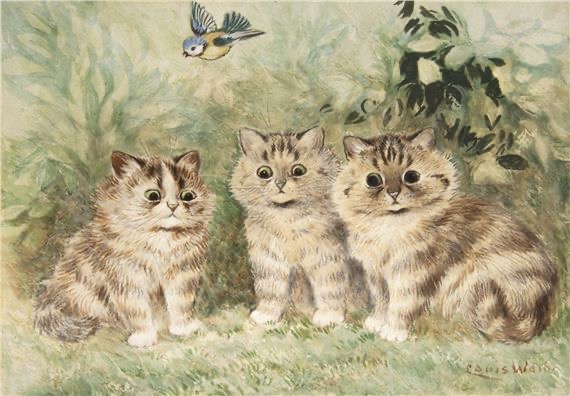
Untitled
Wain himself seems to have enjoyed knowing that the outside world still remembered him. He continued to draw, and even newspaper reports from the period emphasised not the disappearance of his ability to work, but the emergence of some new quality in his later art.
His fame also had a very practical effect. According to Dale, the staff knew that journalists might turn up at the hospital at any moment to see how the famous artist was getting on. As a result, Wain received particular attention and, instead of ordinary hospital clothing, was allowed to wear a neat tweed suit.
It would be a mistake, however, to conclude from his preserved ability to draw that Wain simply remained a harmless eccentric in old age. His delusional beliefs did not disappear, his speech could become incoherent, and his independence in everyday life declined noticeably.
He developed an obsessive fear of the cold. Even on the hottest day in July, Wain might close the windows, saying that “the icy winds are here”, and wrap himself in several layers of clothing: woollens, a scarf, gloves, and a cap that he sometimes kept on even in bed.
It also became increasingly difficult to persuade him to wash properly or change his clothes. He developed unusual dietary and medical habits: for example, he became extremely fond of liquid paraffin and, if left unsupervised, would not only drink it but rub it into his hair. When staff prevented him from doing such things, Wain could become irritated, demand the police, and even begin barking like a dog.
The result is a strange but important combination: a man who was increasingly unable to manage some basic aspects of everyday life, whose speech could become incoherent, and who continued to hold pronounced delusional beliefs — yet who was still capable of producing technically complex drawings.
In 1934, the last book published during Wain’s lifetime appeared: Louis Wain’s Great Big Midget Book, produced with the involvement of his sister Claire. According to Dale, some of the illustrations included in it had been made quite recently, while Wain was already in hospital.
Even in his final years, Wain continued to work from time to time. The press noted that drawing was becoming increasingly difficult for him, yet he would still occasionally return to it “with energy and intelligence”. Hospital staff and their children later remembered Wain as a quiet, kindly old man with a full grey beard, who might sit in the garden, talk to children, and give them his drawings.
What was the illness?
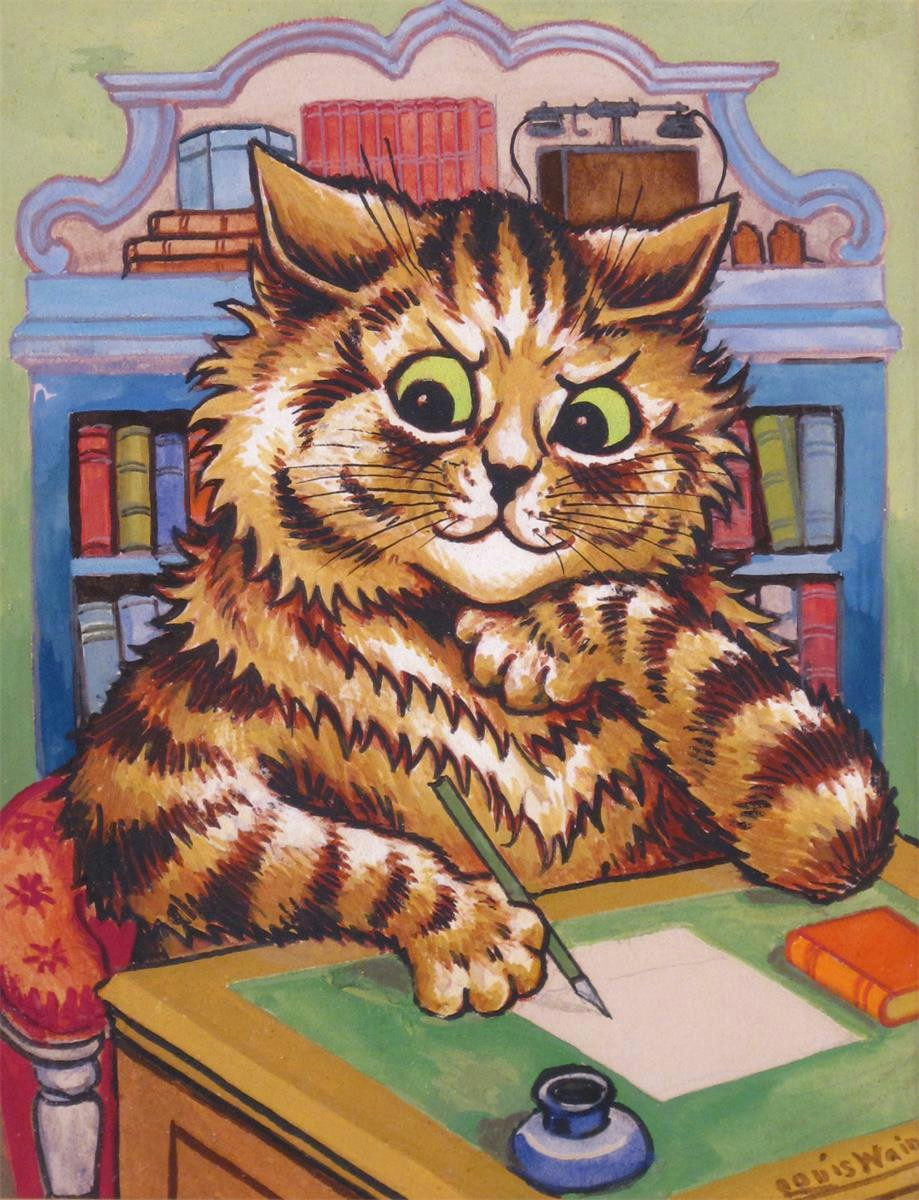
Dr. Alan Barham Carter As A Cat, almost certainly 1933
A separate chapter of Dale’s book is devoted to the question of what exactly Wain was suffering from. The original medical section of the biography was written by psychiatrist David L. Davies, although the text was substantially revised for the 1991 edition, so not every statement in the later version can automatically be attributed to him.
The chapter begins with a very reasonable caveat: diagnosing a psychiatric condition in someone decades after their death is extremely difficult. Nevertheless, the author then reaches a fairly definite conclusion: Wain suffered from schizophrenia. As evidence, he points to the gradual development of delusions, changes in behaviour, suspiciousness, and the later decline in Wain’s ability to manage everyday life normally. Wain’s sister Marie is placed within the same framework and is likewise retrospectively described as having suffered from schizophrenia.
Moreover, many features of Louis’s personality long before his hospitalization — his reserve, eccentricity, tendency to fantasise, habit of drifting away from the main subject of a conversation, and unusual theories about electricity and health — are interpreted as early signs of some innate predisposition. By the end of the chapter, the author effectively suggests that both Louis and Marie were born with an increased susceptibility to schizophrenia, while the difficulties of life gradually intensified characteristics that had already been present.
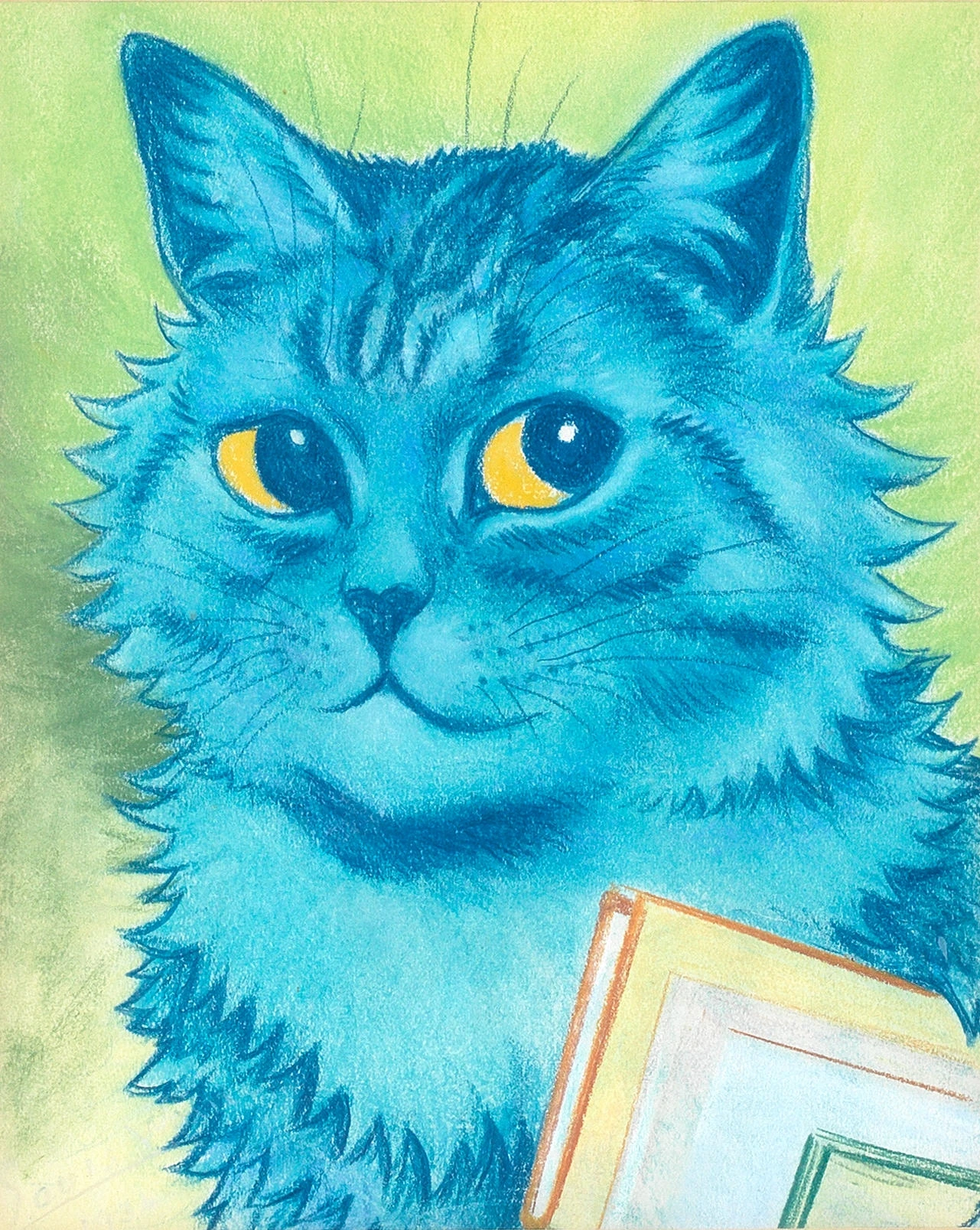
Pensive Puss, 1934
This interpretation, however, should be treated with caution.
First, it is itself retrospective. In Wain’s surviving Bethlem case record, the diagnosis is not schizophrenia but paraphrenia. Paraphrenia and schizophrenia were historically closely related, and the boundaries between the diagnoses changed over time, but they were not simply two names for exactly the same disorder. Paraphrenia was generally used for psychotic conditions involving a well-developed system of delusional beliefs alongside a comparatively greater preservation of personality and other mental functions.
The concept of schizophrenia later broadened, while paraphrenia gradually fell out of widespread use. It is therefore quite possible that the author of the chapter was effectively reinterpreting a diagnosis made in the 1920s through the framework of a later psychiatric system.
Second, some of the chapter’s reasoning illustrates just how much psychiatric language has changed over time. Wain’s earlier shyness, tendency to fantasise, and eccentricity, for example, are linked to a “schizoid personality”, treated almost as a milder expression of the same characteristics that supposedly emerged later in schizophrenia. Today, drawing such a direct line between an unusual personality and a later psychotic disorder would be extremely risky.
The same applies to Wain’s earlier theories. There is certainly an intriguing continuity of subject matter: as far back as the 1890s, he was writing about electricity, ether, health, and the effects of physical forces on the body, while during his illness electrical “currents” and ether became part of his delusional beliefs. But similarity of content does not prove that the earlier ideas were themselves symptoms of illness. Wain was, after all, a highly imaginative man who was interested in popular science and developed some fairly wild theories long before any obvious psychosis appeared.

Cats' Christmas. Allderidge dates this painting to 1935. Note that this image appears to have been flipped horizontally for some reason
At the same time, the chapter draws attention to an important point: Wain’s condition does not look much like a simple, global collapse of all his mental abilities.
The author considers the possibility of an organic brain disorder related to age, vascular changes, or the effects of the old head injury, but notes that many of Wain’s abilities remained comparatively well preserved for a long time. Even during his illness, contemporaries repeatedly commented on the preservation of his artistic skill.
This fits particularly well with the Bethlem case record itself. There, two things that may initially seem almost contradictory exist side by side: pronounced and persistent delusions, and a man who continues to work, converse with people around him, write a coherent letter, and produce paintings that the doctors themselves sometimes explicitly describe as good. In this respect, the historical diagnosis of paraphrenia is especially interesting. It does not tell us what diagnosis Wain would receive today, but it fits remarkably well with the picture preserved in the surviving records.
The “kaleidoscopic” cats
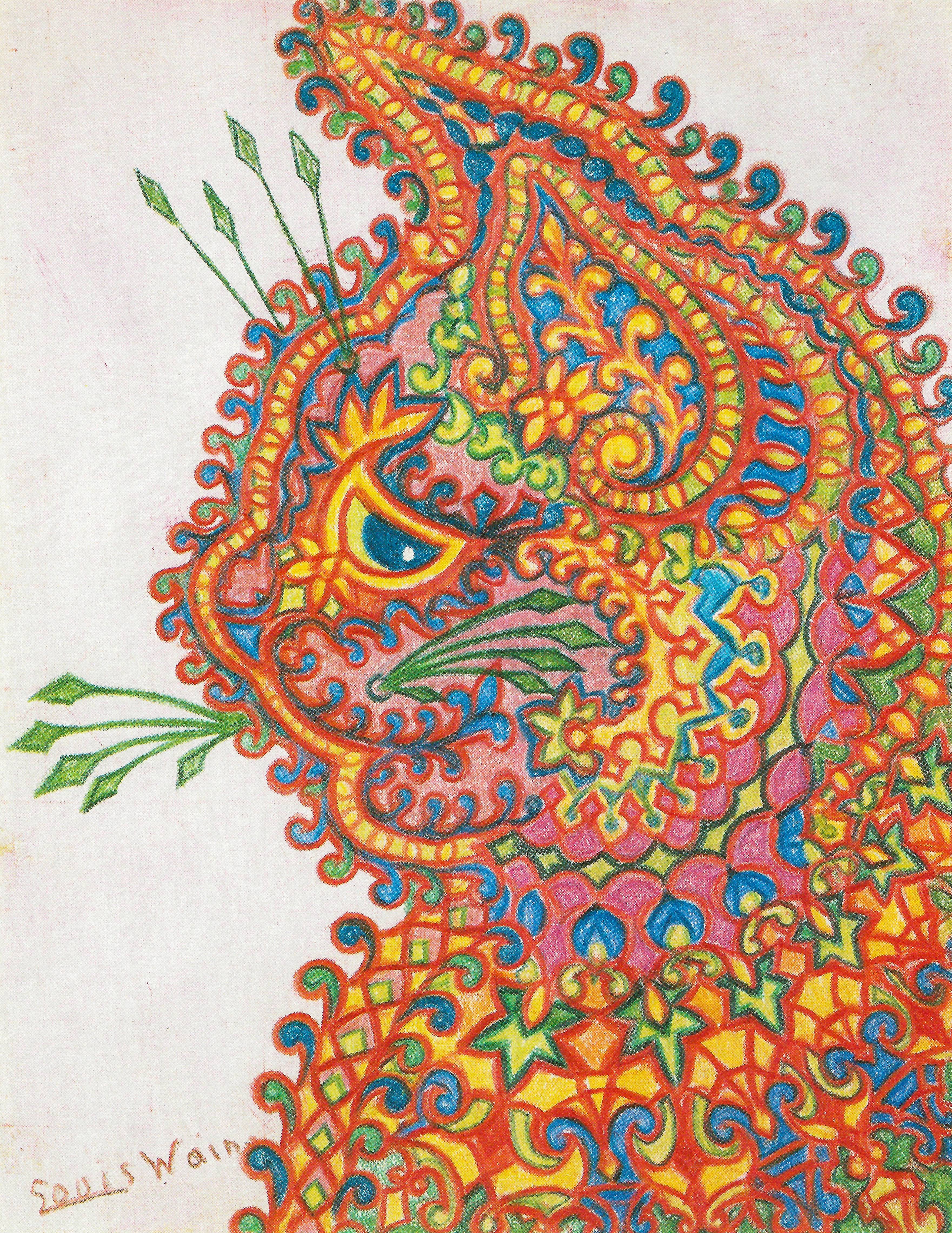
Title and date unknown
The best-known story about Wain goes something like this: at first he drew perfectly ordinary cats, then his illness progressed, the images became increasingly strange and geometric, until eventually the cat almost completely dissolved into a symmetrical abstract pattern.
As far as I can tell, this story began eleven years after the artist’s death, when two of his works appeared in the book Psychotic Art to illustrate the “breakdown of conceptual thinking” and “tendency toward stylization” supposedly characteristic of schizophrenia. Over the following decades, these “fractal cats” appeared in other books as well, where readers were solemnly told: look how the patient’s work changed as his condition deteriorated, becoming increasingly strange and disturbing.
The problem is that this famous sequence appears to have no connection whatsoever with the actual chronology of the pictures.
During the 1930s, psychiatrists Eric Guttmann and Walter Maclay were studying artistic production in relation to mental illness and collecting relevant material. Their collection later became part of the holdings of the Bethlem museum. Maclay in particular played the key role in creating the familiar story about the supposed development of Wain’s art.
In a letter sent to Napsbury Hospital on 31 July 1939, Maclay explained that he had found several drawings by Wain in a small shop in Notting Hill, executed in completely different styles. There were eight works in total. They included fairly conventional portraits of cats, more decorative images, cats surrounded by elaborate coloured patterns, and almost entirely abstract symmetrical compositions.
Knowing that the artist had spent many years in psychiatric hospitals, Maclay assumed that some of the works had been produced earlier and others during later stages of the illness. In the same letter, the psychiatrist asked for information about Wain’s condition during the final years of his life and whether he had continued to draw.
In the reply, a member of the hospital staff reported that Wain had remained absorbed in his work right up until his death and that his pictures had continued to be very good, although some deterioration in technique had become noticeable during his final years. Allderidge notes with some irritation that despite this, and despite the lack of dates for most of the works, Maclay continued to work from the assumption that the “disintegrating cats” had been drawn during the later stages of Wain’s illness.
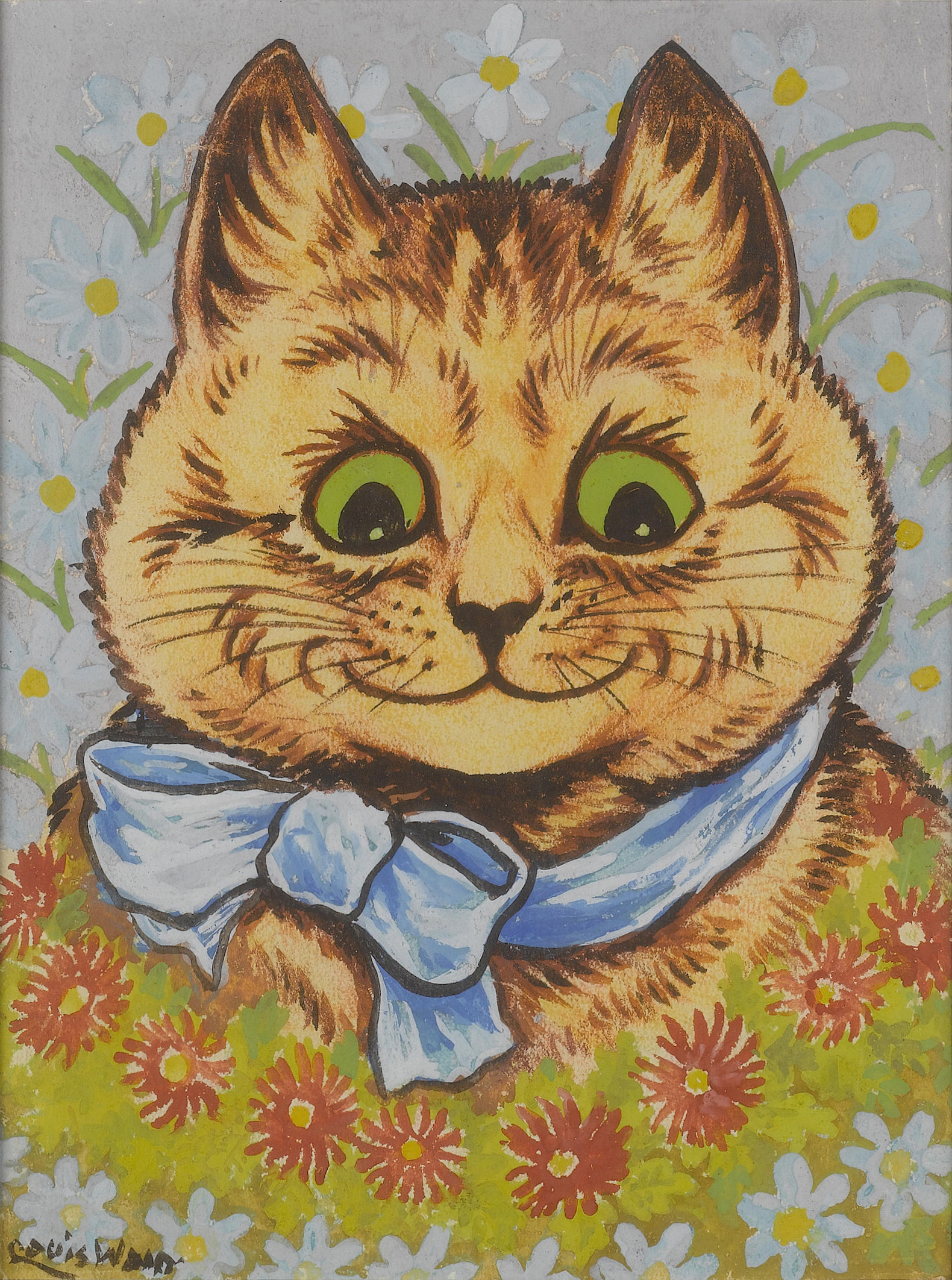
Happy Flower Cat, 1933
So, once again: Maclay himself arranged these eight drawings into a supposed chronological sequence which, in his view, demonstrated the gradual deterioration of the artist’s mental state. He had no dates to confirm that order. Interestingly, Allderidge notes that the “Maclay sequence” she saw does indeed match the one shown at the beginning of this article, although the order of the pictures appears to have been changed at least twice over the years.
Dale rather pointedly describes the situation with the Latin phrase post hoc ergo propter hoc: simply placing one thing after another does not mean that the first turned into the second. More importantly, the surviving evidence and medical records fit this neat linear scheme rather poorly.
At Springfield, Wain continued to draw extensively, and after his transfer to Bethlem the doctors initially saw no noticeable decline in his artistic ability at all. At Napsbury, the story becomes even more revealing. According to the recollections of one nurse, in 1933 Wain temporarily lost almost all interest in cats and turned instead to brightly coloured geometric ornament, referred to there as wallpaper designs. But this period lasted only until around 1935. Afterwards, partly under pressure from his sisters, who needed more commercially viable work, Wain returned to his familiar feline subjects.
This is precisely what fits so badly with Maclay’s famous sequence. If the decorative and almost abstract compositions really represented an irreversible stage in the “disintegration” of Wain’s artistic thinking, why did he later return to his earlier subject matter and produce perfectly recognisable images of cats again? In reality, at different points in his later life he experimented with ornament, abstract forms, colour, and his familiar feline subjects.
Truth and myth
Allderidge writes that a major boost to the myth of the “disintegrating cats” came from Art and Psychotic Illness, a 1963 article by British psychiatrist Professor George Morrison Carstairs, published in the medical journal Abbottempo. A few years later, Carstairs developed the same theme in The Madness of Art, published in The Observer in 1966.
Carstairs worked at the Maudsley Hospital, where Maclay had also worked, and became something of a specialist on the Guttmann–Maclay collection. In his article, he reproduces several pictures from the now-familiar sequence, while rearranging some of them into a different order. Carstairs writes that Wain’s cats supposedly began as “realistic, lovable and full of life”, but later became “increasingly stylized, fragmented, frightening and strange”.
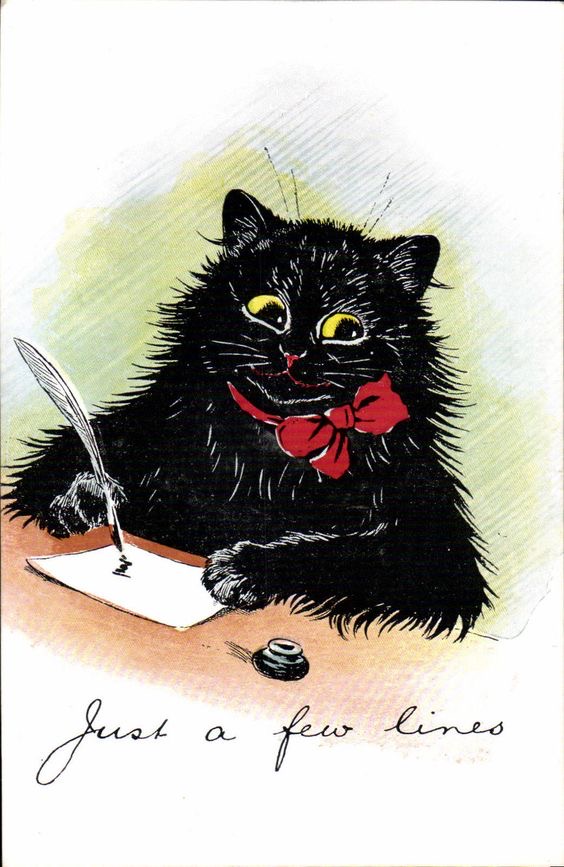
Just a Few Lines
In her monograph, Allderidge argues strongly against interpretations of this kind, noting rather sadly that by now the myth is almost impossible to dispel, especially after spreading through countless books and, later, across the internet. Patricia points out that four of the pictures were made in coloured pencil and the other four in gouache. The first two, in fact, have very little connection with the rest, while the third is unrelated to any of the other works in the group.
The remaining images do have more in common, but Allderidge suggests viewing them not as successive stages in the “disintegration” of a cat, but as decorative compositions built around a recognisable feline head and paisley ornament. Such patterns would have been very familiar to Wain: they were widely used on Kashmir shawls and on their European, especially Scottish, imitations, which became enormously popular during the second half of the nineteenth century. Textiles were also familiar territory through his family background: his grandfather was involved in silk manufacture, while his father worked as a commercial traveller for a textile firm.
More importantly, pictures of this kind were by no means typical of Wain’s late work. Allderidge writes that, as far as is known, they are virtually unique. Other drawings by Wain have since been found that resemble one of the works in the series, but these contain individual paisley elements rather than “disintegrating” cats. There are also known hospital works in which such ornament appears alongside a cat or fills its silhouette, but Allderidge could find no other examples in which the cat’s head itself seems to be constructed out of the pattern.
The technique used to make the pictures is even more revealing. Wain first laid out some of his ornamental drawings on a square grid, which he then used to construct the composition carefully. Traces of such a grid can also be seen in several pictures from the famous series. In Allderidge’s view, this suggests not the spontaneous breakdown of an image, but the opposite: a deliberate and carefully controlled process of construction — “integration”, not “disintegration”.
Finally, when it comes to the question of why Wain produced such unusual works at all, Allderidge offers the simplest answer: why not? Even during his illness, he remained a skilled artist and retained the ability to create complex compositions. In hospital, he no longer had to keep producing commercial pictures simply to earn money, which gave him more freedom to experiment. Wain loved cats, bright colours, and decorative patterns, and he may simply have decided to combine all three.
Turning these eight images into a kind of visual medical chart — “here is normal Wain, here schizophrenia begins, and here the personality has finally disintegrated” — is therefore completely unsupported by the historical evidence. Dale reaches much the same conclusion: what we have are simply several works by Wain, produced at different points in his life. The fact that someone later arranged them into a dramatic sequence tells us far more about how these pictures were interpreted in the twentieth century than it does about the actual course of Wain’s illness.
Rīga, 2026